

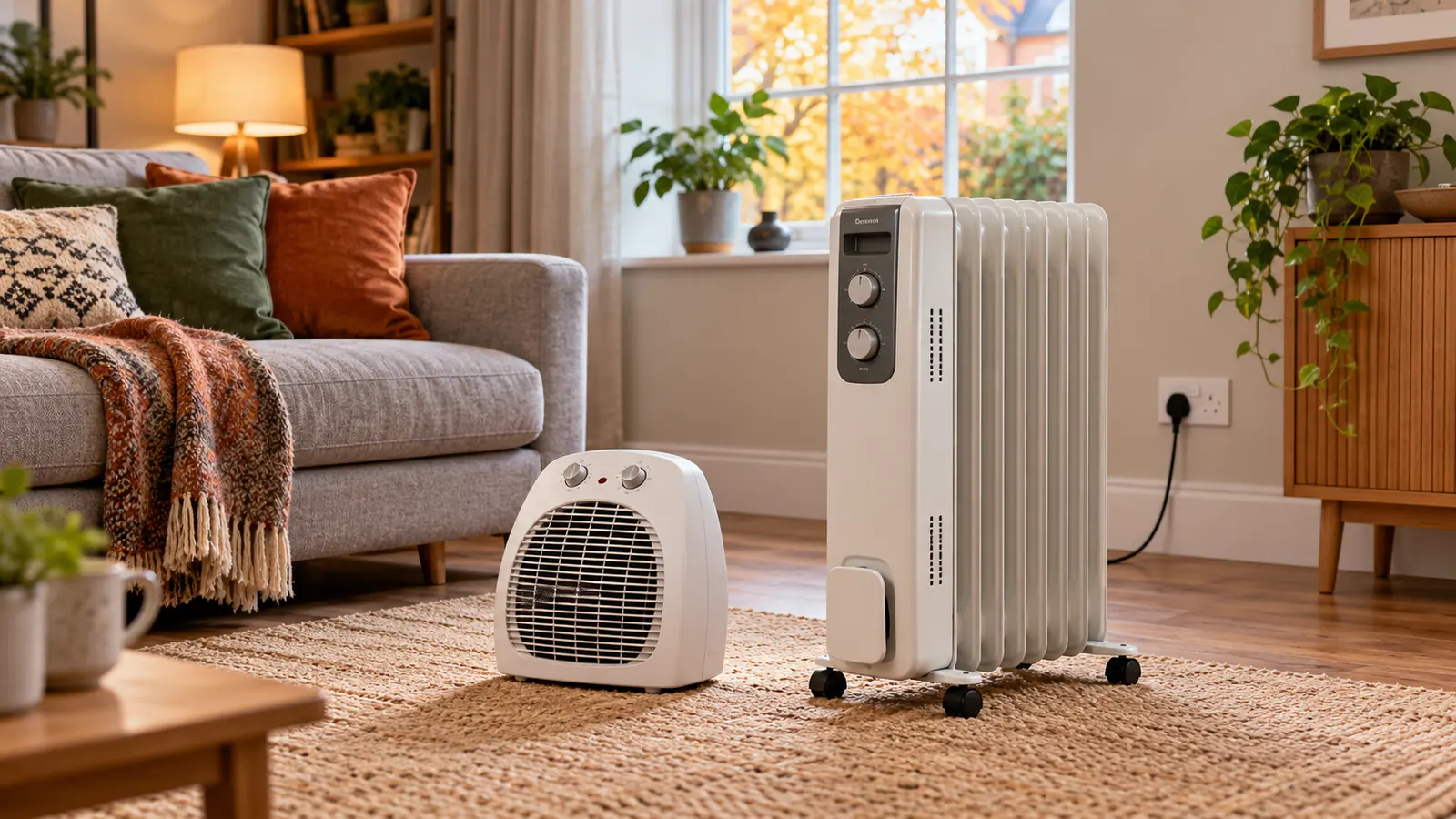
How much does a portable electric heater cost to run?
At Ofgem’s Great Britain Direct Debit comparison rate of 26.32p per kWh for 1 October to 31 December 2026, a 1 kW heater costs up to 26p an hour, a 1.5 kW heater about 39p, a 2 kW heater about 53p and a 3 kW heater about 79p. Electrical Safety First says radiator and fan heaters are typically rated at 2,000 to 3,000 watts, although the label on your own appliance is the figure that matters.
Ofgem’s figure is an average price-cap rate for England, Scotland and Wales, not a universal tariff. Rates vary by region, payment method and deal. Northern Ireland has a separate electricity market, so use the unit rate on your bill or the Consumer Council’s tariff comparison information rather than the Ofgem average.
- 1 kW for one hour: 1 kWh; 26.32p at 26.32p/kWh.
- 1.5 kW for one hour: 1.5 kWh; 39.48p, or about 39p.
- 2 kW for one hour: 2 kWh; 52.64p, or about 53p.
- 3 kW for one hour: 3 kWh; 78.96p, or about 79p.
Use this electric heater cost formula
The formula is: cost = power in kW × time in hours × electricity price per kWh. Divide watts by 1,000 to get kilowatts. If your rate is in pence, the answer will be in pence; divide by 100 for pounds.
Worked example: a heater rated at 2,000 W is 2 kW. Running it at full power for four hours uses 2 × 4 = 8 kWh. At 26.32p per kWh, that costs 8 × 26.32p = 210.56p, or £2.11. Repeating that every day for 30 days would use 240 kWh and cost £63.17.
Check the rating plate, manual or manufacturer’s specifications. If the heater has 1 kW and 2 kW settings, calculate with the setting you use. Do not confuse the thermostat temperature with watts: turning the thermostat higher does not change the element’s stated power, but it can make the element stay active for longer.
Why your meter may show less than the maximum
The label calculation assumes full rated power continuously. Once the room reaches the thermostat setting, many heaters cycle the element off and on. Insulation, draughts, room size, outdoor temperature and thermostat setting all affect how often it cycles.
For a real-world figure, take electricity meter or smart-meter readings immediately before and after a controlled test when other large appliances are off. A suitable plug-in energy monitor can measure many portable heaters, but check that both the monitor and socket arrangement are rated for the appliance’s sustained load. Never use an extension lead just to add a monitor.
Are fan, oil-filled and halogen heaters cheaper to run?
At the same electrical power and for the same active time, direct electric heaters use the same number of kWh. A 2 kW fan heater and a 2 kW oil-filled radiator both use up to 2 kWh in an hour while their elements remain on. Labels such as oil-filled, ceramic, convection or halogen do not override the watts-and-time calculation.
The useful difference is how heat is delivered and controlled. Fan heaters provide quick warm air, halogen heaters direct radiant heat, convection heaters warm circulating air, and oil-filled radiators release stored heat after the element switches off. Choose for brief, directed warmth or steadier room heating.
Compare wattage, setting and measured active time rather than how hot a heater feels. A lower-power model can cost less per hour but may need to run longer.
When a portable heater makes sense
Energy Saving Trust describes portable heaters as secondary heating. They can be useful for warming one room for a short period or adding heat during a cold snap, but can be expensive for regular whole-home heating because standard-rate electricity costs more per unit of heat than many main heating systems.
Use the heater in the occupied room, close doors where appropriate and reduce avoidable draughts without blocking ventilation. Choose a comfortable thermostat setting. If several rooms need heat for long periods, compare the cost and controls of your main system.
A time-of-use tariff can reduce the price only when the heater runs during a genuinely cheaper window. Check the exact tariff schedule. A normal single-rate tariff charges the same price per kWh throughout the day.
Portable heater safety checklist
Electrical Safety First advises placing a portable heater on a level surface at least one metre from combustible materials such as paper, furniture and curtains. Do not dry clothes on or close to it, do not leave it unattended or use it while asleep, and do not power it from an extension lead because the lead can be overloaded.
Buy from a reputable retailer, follow the manufacturer’s instructions and register the product so you can be contacted about recalls. Stop using it if the plug or socket becomes hot, you see burn marks, hear buzzing or crackling, smell burning, or a fuse or circuit breaker repeatedly operates. Have a faulty appliance or socket checked by a competent professional.
Keep vents and grilles clear. Choose appropriate tip-over protection where needed, especially around children or pets, and keep smoke or heat alarms in working order. Cost savings are never a reason to bypass a safety feature or use a damaged heater.
How to estimate a week or month accurately
Start with the heater’s kW setting and your exact tariff rate. Record the hours used each day for a representative week. Multiply kW by active hours and the rate, then add the daily results. If the thermostat cycles, use a plug-in monitor that is safely rated for the load or compare meter readings instead of assuming full power for every clock hour.
Keep the portable-heater cost separate from the standing charge. The standing charge belongs in a full household bill calculation and does not rise because the heater runs longer. Recheck the estimate when your tariff changes, when you use a different power setting or when colder weather makes the heater cycle more often.
Portable electric heater running cost FAQs
How much does a 2 kW heater cost to run for one hour?
At 26.32p per kWh, a 2 kW heater costs up to 52.64p, or about 53p, for one hour at full power. Multiply 2 kW by your own unit rate for a personal figure.
Does an oil-filled radiator use less electricity than a fan heater?
Not simply because it contains oil. At the same rated power and active time, both use the same kWh. Their warm-up, heat delivery and thermostat cycling differ, so measured use in a particular room can differ.
Is it cheaper to leave an electric heater on low all day?
Usually the cost depends on total kWh, not a special benefit from running continuously. A lower setting draws less power while active, but long operating time can outweigh that saving. Heat only when needed and use suitable controls.
Can I plug a portable heater into an extension lead?
Electrical Safety First advises against powering a portable heater from an extension lead because it can be overloaded. Plug the heater directly into a suitable wall socket and follow the manufacturer’s instructions.
Estimate your electricity bill
Add the heater’s kWh to your other household use when estimating the whole bill. Use your actual unit rate and meter readings. Do not add the standing charge to each hour of heating because that daily charge is payable for the home whether the portable heater is on or off.
Sources
Power ratings, tariff figures, heating guidance, appliance-cost advice and safety recommendations were checked against these sources on 19 October 2026:
- Ofgem: Energy price cap unit rates and standing charges
- Energy Saving Trust: Electric heating
- Electrical Safety First: Portable heaters
- Electrical Safety First: Ratings of electrical appliances
- Citizens Advice: Compare appliance running costs
- Consumer Council: Northern Ireland electricity price comparison