

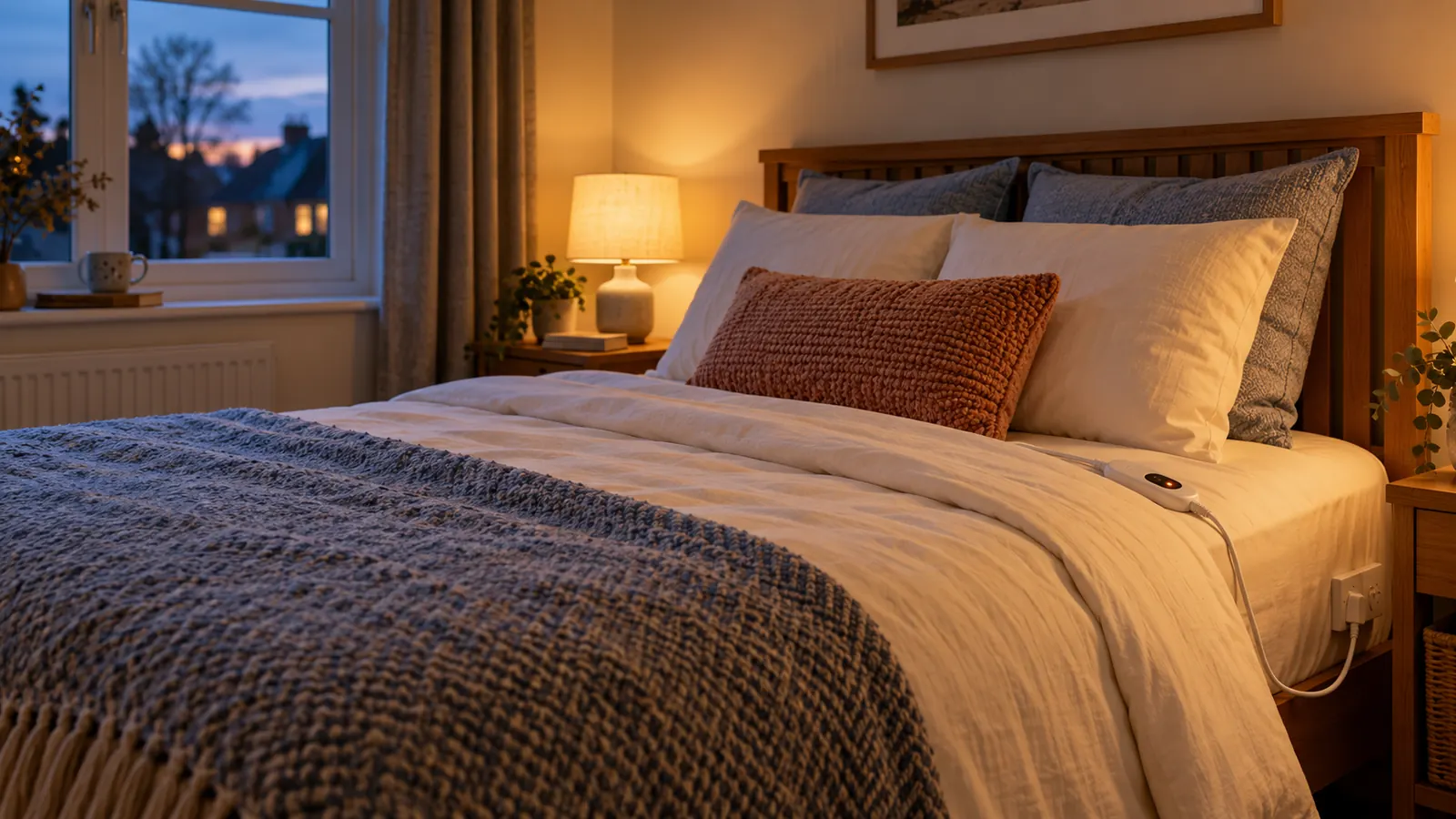
How much does an electric blanket cost to run?
Electrical Safety First says electric blankets are typically rated at 80–120 watts, with double-controller models generally using more power. At Ofgem’s Great Britain Direct Debit comparison rate of 26.32p per kWh for 1 October to 31 December 2026, an 80W blanket costs about 2.1p an hour, a 100W model about 2.6p and a 120W model about 3.2p.
For eight hours at the full stated power, those examples cost about 17p, 21p and 25p respectively. Some controls cycle the heat or use less power on a lower setting, so multiplying the maximum wattage by the whole session can be a cautious estimate. The rating plate, instructions or manufacturer’s specification for your blanket is the best starting point.
- 80W for eight hours: 0.64 kWh; 16.84p, or about 17p.
- 100W for eight hours: 0.8 kWh; 21.06p, or about 21p.
- 120W for eight hours: 0.96 kWh; 25.27p, or about 25p.
- 100W for one hour: 0.1 kWh; 2.63p, or about 3p.
Use this electric blanket cost formula
The formula is: cost = watts ÷ 1,000 × hours × unit rate. Dividing watts by 1,000 converts the rating to kilowatts. If the unit rate is in pence per kWh, the result is in pence; divide by 100 for pounds.
Worked example: a 100W blanket is 0.1 kW. Used for eight hours, it consumes up to 0.1 × 8 = 0.8 kWh. At 26.32p per kWh, the cost is 0.8 × 26.32p = 21.056p, or about 21p. Used this way every night for 30 nights, it would consume up to 24 kWh and cost £6.32.
For a dual-control blanket, check whether the stated wattage covers the whole product or each side. If the label gives a range or separate settings, calculate the setting you actually use. A plug-in energy monitor may show real consumption, but only use one that is suitable for the appliance and follow both manufacturers’ instructions.
Preheating the bed versus leaving it on overnight
If the manufacturer permits preheating, one hour at 100W costs about 3p at the illustrative rate. Eight hours at the same full rating costs about 21p. A timer or automatic shut-off can prevent forgotten use, but it must be a feature or arrangement allowed by the product instructions.
Do not assume every blanket is designed for all-night use. Electrical Safety First advises switching it off before bed unless it has an automatic shut-off and the manufacturer says it is suitable for overnight use. People who may be insensitive to heat need particular care; follow the product warnings and seek appropriate advice rather than relying on a general cost guide.
Why your tariff changes the answer
Ofgem’s 26.32p figure is an average price-cap rate for a standard variable tariff paid by Direct Debit in England, Scotland and Wales. It is not a universal price. Region, payment method, meter and tariff can all change the unit rate, while a fixed deal may not match the cap.
Northern Ireland has a separate electricity market and Ofgem’s price cap does not apply there. Use the pence-per-kWh rate on your bill. If you have a time-of-use tariff, calculate preheating and overnight use at the rate that applies in each period rather than using one blended price.
The standing charge is not part of the appliance running cost because it is payable for the home regardless of whether the blanket is used. Include it once when calculating the complete household bill.
Is an electric blanket cheaper than a room heater?
An electric blanket usually has a much lower power rating because it warms the bed and person directly rather than the whole room. For context, Electrical Safety First lists electric blankets at typically 80–120W and radiator or fan heaters at typically 2,000–3,000W. At full rated power, a 100W blanket uses 0.1 kWh an hour while a 2kW heater uses 2 kWh.
That is a power comparison, not a claim that the appliances provide equivalent heating. An electric blanket does not warm the room or protect a cold home from damp and frozen pipes. Do not turn essential heating below a safe level, and never use a blanket in a way the manufacturer prohibits simply to save money.
Electric blanket safety checks before use
Check the blanket, plug, controller and cable before use, especially after storage. Stop using it if you find scorch marks, discolouration, frayed or exposed wires, a damaged cable, unusual hot spots or signs of rodent damage. Electrical Safety First recommends considering replacement when a blanket is 10 years old or more and buying from a reputable retailer.
Keep it flat: do not switch it on while folded, rucked or creased. Never use it wet, touch it with wet hands or feet, insert pins, or combine it with a hot-water bottle. Use an underblanket only under the occupant and an overblanket only above them. Check the instructions before washing and make sure any permitted washable product is completely dry before reconnecting it.
Electrical Safety First reported 31 accidental electric-blanket fires in England in 2024/25, a five-year high, with 11 casualties and/or fatalities. Those figures are for England and should not be presented as a UK total. The practical lesson is to treat damage and incorrect use as safety issues, not small defects to work around.
How to get a more accurate monthly estimate
Find the wattage on the product label or in the manual, note the heat setting and record how long the blanket runs each night. Calculate each tariff period separately if your price changes overnight. Multiply the daily kWh by the number of nights you expect to use it, then revisit the estimate if your routine or tariff changes.
If a dual-zone blanket lets you heat only one side, use that control where the instructions allow it. Automatic shut-off can limit accidental extra hours, while a lower comfortable setting may use less energy on products with variable power. Safety features should never be bypassed for a marginal saving.
Electric blanket running cost FAQs
How much does an electric blanket cost to run for eight hours?
At 26.32p per kWh, an 80W blanket costs about 17p for eight hours at full rated power, a 100W blanket about 21p and a 120W blanket about 25p. Use your own wattage and tariff for a personal figure.
How much electricity does a 100W electric blanket use?
A 100W blanket uses up to 0.1 kWh per hour at full power. That is 0.8 kWh over eight hours, although a thermostat or lower setting may reduce actual consumption.
Can I leave an electric blanket on all night?
Only if the manufacturer says the product is designed for overnight use. Electrical Safety First advises switching it off before bed unless it has an automatic shut-off. Always follow the specific instructions and warnings.
Can I use an electric blanket with a hot-water bottle?
No. Electrical Safety First says never to combine them because leaking water coming into contact with the electric blanket could create an electric-shock risk.
Calculate your appliance running costs
Enter watts and hours or kWh per cycle, then compare costs for different usage patterns.
Estimate your electricity bill
Add the blanket’s calculated kWh to your other household use when estimating the full bill. Use your actual unit rate and do not assign the daily standing charge to the blanket: you pay that charge whether the blanket is switched on or off.
Sources
Power ratings, tariff figures, appliance-cost guidance and safety recommendations were checked against these sources on 20 October 2026: