

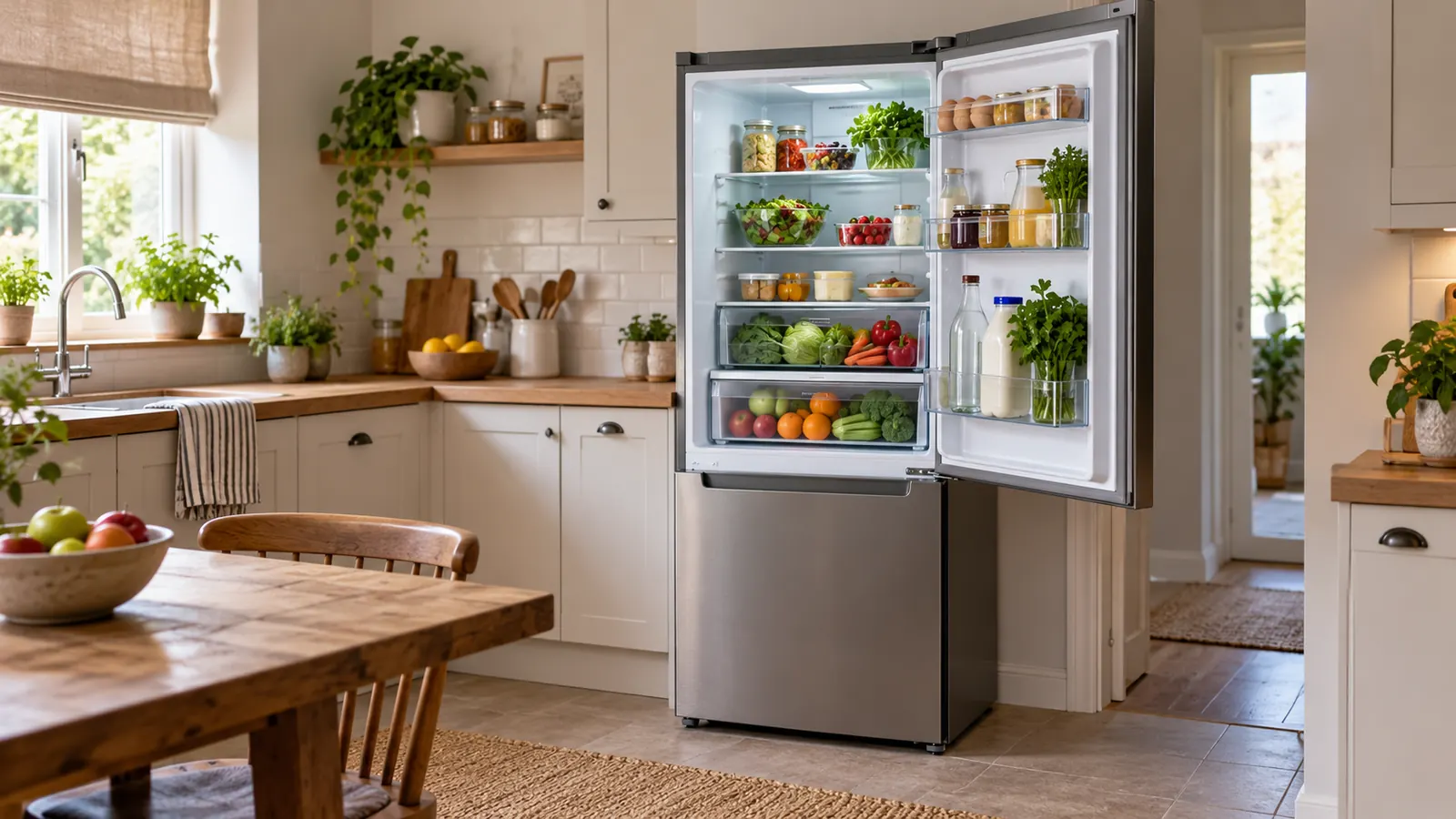
How much does a fridge freezer cost to run?
At Ofgem’s Great Britain Direct Debit comparison rate of 26.32p per kWh for 1 October to 31 December 2026, a fridge freezer using 120 kWh a year costs about £31.58 annually. A 180 kWh model costs about £47.38, while a 280 kWh model costs about £73.70. These are worked examples, not average claims for every appliance.
Unlike an oven or washing machine, a fridge freezer cycles on and off around the clock. Its instantaneous wattage does not tell you its annual cost reliably because the compressor runs only when cooling is needed. Use the energy label’s annual kWh figure, the product information sheet or a representative long-term measurement instead.
- 120 kWh a year: 120 × £0.2632 = £31.58 a year, or about £2.63 a month.
- 180 kWh a year: 180 × £0.2632 = £47.38 a year, or about £3.95 a month.
- 280 kWh a year: 280 × £0.2632 = £73.70 a year, or about £6.14 a month.
- Each extra 100 kWh a year adds £26.32 at the example rate.
Calculate the cost from the energy label
Current household refrigerating-appliance labels use an A-to-G efficiency scale and show annual energy consumption in kWh. Use: annual running cost = annual kWh × electricity price per kWh. If your bill shows the rate in pence, divide it by 100 before calculating a result in pounds.
For a label showing 180 kWh a year and a tariff of 26.32p per kWh, convert 26.32p to £0.2632. Multiplying 180 by £0.2632 gives £47.376, which rounds to £47.38. Divide by 12 for an average monthly cost or by 365 for an average daily cost.
The label also shows the chilled and frozen compartment volumes, the efficiency class and noise information. Compare annual kWh between appliances that give you the capacity you genuinely need. A larger appliance can use more electricity even when it has the same letter grade as a smaller one.
Worked daily, monthly and annual examples
A 180 kWh fridge freezer averages 15 kWh a month when annual consumption is divided evenly. At 26.32p per kWh, that is £3.948, rounded to £3.95. Its daily average is about 0.493 kWh, costing 12.98p. The appliance does not consume exactly that amount every day; this is simply the annual label estimate spread across the calendar.
Comparing a 180 kWh model with a 280 kWh model gives a 100 kWh annual difference. At the example tariff, the lower-consumption model would cost £26.32 less for one year. Electricity prices and real-world use change, so do not multiply that saving across an appliance’s whole life without allowing for future rates and performance.
Energy Saving Trust says choosing an A-rated fridge freezer instead of an E-rated one can save around £360 in Great Britain over an assumed 17-year lifetime. That is a comparison under its stated assumptions, not a promise for every pair of models. Check the specific annual kWh figures, purchase price, size, warranty and repairability before buying.
Why your real electricity use can differ
The standard label creates a consistent basis for comparing products, but a kitchen is not a test laboratory. A warm room, poor ventilation around the appliance, frequent door opening, damaged seals, heavy frost or placing warm food inside can make the compressor run for longer.
Settings matter too. The Food Standards Agency recommends keeping a household fridge at 5°C or below and a freezer at -18°C or below. Use a fridge-freezer thermometer if the controls do not show an actual temperature. Do not raise the temperature beyond safe guidance simply to reduce the electricity bill.
A plug-in energy monitor can measure some appliances, but it must be suitable for the fridge freezer’s load and used exactly as its manufacturer directs. Measure for several days rather than a few minutes because compressor cycles vary. A whole-home monitor cannot normally isolate one appliance precisely unless everything else is accounted for.
Use the unit rate on your own tariff
Ofgem’s 26.32p figure is an average comparison rate for standard-variable-tariff customers paying by Direct Debit in England, Scotland and Wales. Actual rates vary by region, payment method, meter and tariff. Copy the pence-per-kWh rate from your bill or supplier notice for a personal result.
Northern Ireland has a separate electricity market and is not covered by Ofgem’s Great Britain price cap. The Consumer Council publishes current supplier and tariff comparisons, but your own bill remains the right input because prices and discounts differ.
If you have Economy 7 or another time-of-use tariff, a fridge freezer uses electricity during both peak and off-peak periods. A single annual kWh figure does not show when that consumption occurred. For a close estimate, apply a blended rate based on your meter data rather than assuming all refrigeration use receives the cheaper rate.
Do not add the daily standing charge to the fridge freezer. You pay that household charge whether the appliance is running or not. Include it once only when using the main electricity bill calculator to estimate the complete bill.
Safe ways to reduce fridge freezer costs
Keep the door seals clean and check that they close evenly. Open the doors only as long as needed, allow cooked food to cool promptly before chilling it, and defrost a manual-defrost freezer when ice builds up, following the appliance instructions. Leave the ventilation clearances specified by the manufacturer so heat can escape.
Avoid both extremes when loading. A packed fridge can restrict cold-air circulation, while an unnecessarily large appliance cools more space than the household needs. Energy Saving Trust advises choosing an appropriately sized model and comparing the annual kWh figure, not the letter class alone.
Do not switch a working fridge freezer off overnight to save money. Refrigeration protects perishable food, and repeated warming can create avoidable waste and safety risks. If the appliance runs continuously, forms unusual amounts of ice, feels excessively hot outside, makes new noises or cannot hold a safe temperature, check the manual and arrange competent repair advice.
Should you replace an older fridge freezer?
First find the old appliance’s actual annual consumption with a suitable monitor or a reliable product specification. Compare that with the label kWh of a suitable replacement and multiply the difference by your tariff. This gives the annual electricity saving before purchase, delivery and disposal costs.
For example, replacing a measured 400 kWh appliance with a 180 kWh model would reduce the estimate by 220 kWh, worth £57.90 for one year at 26.32p per kWh. A £600 replacement would not pay back through that electricity saving alone for more than ten years if all assumptions stayed unchanged. A failing appliance, unsuitable capacity or repeated repair costs may still change the decision.
If you replace one, use the retailer’s take-back or a legitimate recycling route. Do not damage refrigerant pipes or abandon the appliance. Keeping a serviceable model can sometimes be better value than replacing it solely for a modest energy saving.
Fridge freezer running cost FAQs
How much does a fridge freezer cost to run per day?
Divide its annual kWh by 365, then multiply by your unit rate. A 180 kWh model averages about 0.493 kWh and 12.98p a day at 26.32p per kWh. Daily use varies with conditions and compressor cycles.
How do I find my fridge freezer’s electricity use?
Look for annual energy consumption in kWh on the energy label or product information sheet. For an older appliance, search the exact model documentation or use a suitable energy monitor over several days.
Does a better energy rating always mean a lower bill?
Not necessarily when sizes differ. The A-to-G class measures efficiency for the appliance category, while annual kWh shows the estimated electricity used. Compare both capacity and annual kWh.
Can I turn my fridge freezer off at night?
No. It needs to maintain safe food temperatures continuously. The Food Standards Agency recommends 5°C or below for a fridge and -18°C or below for a freezer.
Is the standing charge part of the fridge freezer cost?
No. The standing charge is for the household supply and remains payable regardless of this appliance. Add it once when estimating the whole electricity bill, not to the appliance running cost.
Calculate your appliance running costs
Enter watts and hours or kWh per cycle, then compare costs for different usage patterns.
Estimate your electricity bill
Add the fridge freezer’s annual kWh to the rest of your household use when estimating a full bill. Use your actual unit rate and include the standing charge only once for the household, not as an appliance cost.
Sources
Tariff rates, energy-labelling rules, efficiency advice and food-temperature guidance were checked against these sources on 24 October 2026:
- Ofgem: October to December 2026 price-cap rates
- GOV.UK: Create a household refrigerating-appliance energy label
- UK legislation: Refrigerating-appliance energy label requirements
- Energy Saving Trust: Home appliances and energy-efficiency ratings
- Energy Saving Trust: How to save energy in the kitchen
- Food Standards Agency: Safe fridge and freezer temperatures
- Consumer Council: Northern Ireland electricity price comparison