

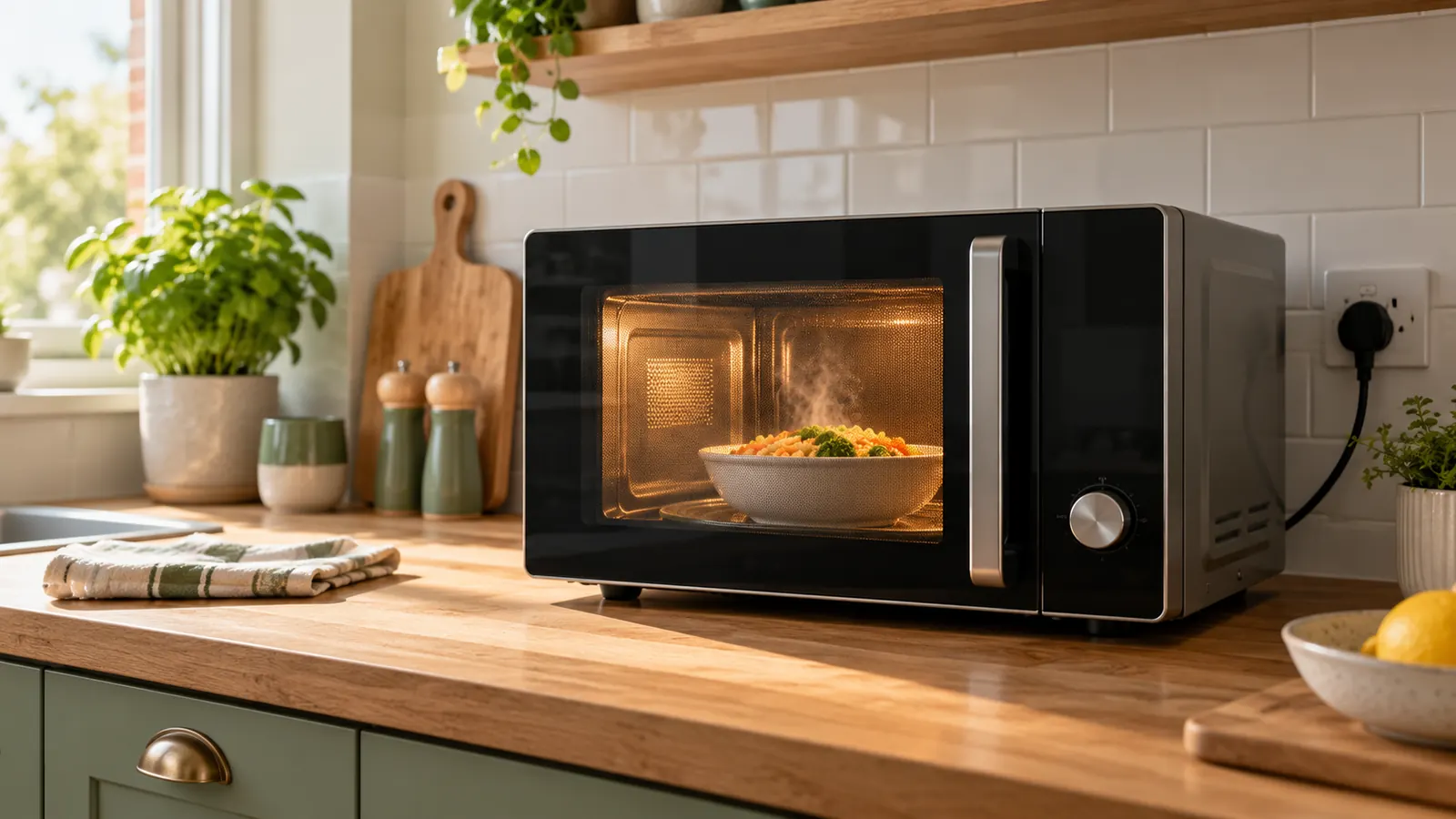
How much does a microwave cost to run?
At Ofgem's Great Britain Direct Debit comparison rate of 26.32p per kWh for 1 October to 31 December 2026, a microwave with a 1,250W electrical input costs about 2.74p for five minutes or 5.48p for ten minutes. Five minutes every day would use roughly 38.02kWh and cost about £10.01 over a year at that unchanged rate.
These are transparent examples, not a claim that every microwave or meal uses the same amount. Combination models may power a grill or convection heater as well as the microwave generator, and automatic programmes can vary the power during cooking. Use the input rating and instructions for the mode you select.
- 1.25kW for five minutes: 1.25 × 5 ÷ 60 = 0.1042kWh, costing about 2.74p.
- 1.25kW for ten minutes: 0.2083kWh, costing about 5.48p.
- Five minutes every day: about 38.02kWh and £10.01 a year at 26.32p/kWh.
- Energy Saving Trust's specific 400g ready-made lasagne test cost 4p in Great Britain and 5p in Northern Ireland.
Use input power, not the advertised cooking watts
A microwave's prominent 700W, 800W or 900W figure normally describes cooking output. The appliance draws more electricity from the socket because energy is also used by its electronics, fan, turntable and the process that produces microwaves. For a cost estimate, look for “power consumption”, “rated input” or similar wording on the rating plate or in the manual.
The distinction is material. One Panasonic 800W-output microwave manual lists microwave power consumption of 1,250W. Using 800W in the five-minute calculation would give 1.75p, while its stated 1,250W input gives 2.74p at the example tariff. That specification illustrates the method; check your own model rather than applying its figures to another appliance.
If the label lists different inputs for microwave, grill and convection operation, use the figure for the selected mode. For a combination programme, a plug-in energy monitor rated for the load can provide a better session measurement. Follow the monitor and appliance instructions, and never defeat the earth connection or use unsuitable adaptors.
Microwave running cost formula
Divide the input watts by 1,000 to convert them to kilowatts. Multiply by the cooking time in minutes and divide by 60 to get kilowatt-hours. Finally, multiply by the unit price shown on your electricity bill. If the rate is in pence, the result is pence; divide by 100 for pounds.
Formula: (input watts ÷ 1,000) × (minutes ÷ 60) × unit rate in pence per kWh = cost in pence. For 1,250W, seven minutes and 26.32p/kWh: 1.25 × 7 ÷ 60 × 26.32p = 3.84p. Ten uses at that duration would therefore cost about 38.38p.
A maximum input calculation can slightly overstate a programme that reduces power during part of its cycle. Measuring one representative session in kWh and multiplying that reading by your unit rate avoids this uncertainty. Do not add the daily standing charge to every meal: it is payable for the household supply whether the microwave is used or not.
Is a microwave cheaper than an electric oven?
A microwave is generally more energy efficient for reheating and quick cooking because it heats the food rather than first heating a large oven cavity. Energy Saving Trust's current laboratory comparison prices a 400g ready-made lasagne at 4p in a microwave in Great Britain and 5p in Northern Ireland. Its figures apply to the tested food, appliance and tariffs, not every recipe.
An oven can still be the practical choice for several portions, crisping or a recipe that needs conventional heat. Batch cooking in a well-filled oven and reheating individual portions later in the microwave can spread the oven's energy across more meals. Compare like with like: the total energy needed for the same edible quantity, not only the appliance's headline power.
A combination microwave using its grill or convection setting is not equivalent to microwave-only mode. Those heating elements can raise consumption and cooking time. Check the manual and, when choosing between appliances, consider food quality, safe cooking instructions and batch size as well as pence per use.
Use your own tariff in Great Britain or Northern Ireland
Ofgem's 26.32p figure is an average comparison rate for standard-variable-tariff customers paying by Direct Debit in England, Scotland and Wales. Your price can differ by region, payment method, meter and tariff. A fixed or time-of-use deal may also be higher or lower, so the unit rate on your own bill is the right figure.
Northern Ireland has a separate electricity market and Ofgem's cap does not apply. The Consumer Council's comparison table shows substantial differences between suppliers, tariffs, payment methods and standing-charge structures. Northern Ireland households should use the unit rate on their bill or current supplier terms; the table was current to 24 October 2026 when checked.
For a time-of-use tariff, use the rate that applies when the microwave runs. Moving a five-minute task to a cheaper period may save only a small amount, so do not compromise food safety or convenience solely to chase an off-peak rate.
Ways to reduce microwave electricity use
Choose the shortest programme that cooks or reheats the food safely, following the food and appliance instructions. Using an appropriate covered microwave-safe container can help retain moisture and reduce splashes, but keep any required vent open. Stirring and standing when instructed helps the heat spread and can avoid repeating a cycle because the centre stayed cold.
Defrost frozen leftovers in the fridge before reheating where it is safe and practical. Energy Saving Trust also recommends using the microwave for quick reheating and switching it off at the plug when it is not needed, provided the manufacturer's instructions allow this and you do not rely on its clock or programmed functions.
Do not buy a replacement solely to save a few pence. Compare the electrical input, functions, size, purchase price and how often you use it. A suitable working microwave used for short jobs is already likely to cost much less per session than room or water heating, so focus first on the largest avoidable household loads.
Microwave food and electrical safety
The Food Standards Agency says reheated food should be steaming hot all the way through and should normally be reheated only once. Follow product and manufacturer instructions, including standing and stirring. Microwaves can leave hot edges and a cold centre, so stir during reheating where instructed and check the whole portion before eating.
Electrical Safety First advises never putting metal or unsuitable containers in a microwave, never leaving food cooking unattended and keeping vents clear. Do not run a high-power microwave from an extension lead. Regularly check its plug and socket for scorching, excessive heat, buzzing or crackling, and stop using it if there is damage to the door or seal.
Clean the cavity and turntable according to the manual so grease and food debris do not accumulate. Built-in models should be installed and repaired by a competent person. Energy saving is never a reason to shorten a safety-critical cooking time or continue using a damaged appliance.
Microwave running cost FAQs
How much does a microwave cost for five minutes?
A 1.25kW-input microwave costs about 2.74p for five minutes at 26.32p/kWh. Use the input power on your own appliance and your actual unit rate because both can differ.
Does an 800W microwave use 800W of electricity?
Not necessarily. The prominent figure usually describes cooking output, while electrical input is higher. One Panasonic 800W-output model lists 1,250W consumption. Check the rating plate or manual for your model's input.
Is a microwave cheaper than an oven?
Usually for reheating or a small quick-cooking task because it heats food without warming a large oven cavity. An oven may be practical for several portions or recipes needing conventional heat, so compare the same quantity of food.
Does a microwave use electricity on standby?
A clock and control electronics can use some standby power. Switch off at the plug when the manufacturer says it is safe and you do not need programmed functions; the saving depends on the model and its measured standby demand.
Should I include the standing charge in microwave cost?
No. You pay the household standing charge whether the microwave runs or not. Use the unit rate for an appliance calculation and add the standing charge once in a full electricity-bill estimate.
Calculate your appliance running costs
Enter watts and hours or kWh per cycle, then compare costs for different usage patterns.
Estimate your electricity bill
Use the appliance cost calculator with your microwave's input watts and cooking time, or add its estimated kWh to the rest of your household use in the main bill calculator. Use your actual unit rate and count the standing charge only once for the home.
Sources
Tariff figures, appliance-cost guidance, tested cooking comparisons, manufacturer specifications, food-safety advice and electrical-safety recommendations were checked against these sources on 27 October 2026:
- Ofgem: October to December 2026 price-cap rates
- Energy Saving Trust: Cooking-appliance cost comparison
- Citizens Advice: Calculate appliance electricity costs
- Panasonic: Example 800W microwave operating instructions
- Food Standards Agency: Safe reheating method
- Electrical Safety First: Microwave oven safety
- Consumer Council: Northern Ireland electricity comparison table