

How to tell whether your electricity bill is estimated
Look beside the opening and closing meter readings on the bill. Suppliers use different labels, but an “E”, “estimated” or similar marker means the figure was not taken from a confirmed reading. An “A” often means actual and a “C” can mean a customer reading; check the bill’s key because the exact notation varies.
Also compare the meter serial number on the bill with the number printed on the physical meter. If they do not match, contact the supplier before trying to reconcile the units. In a block of flats or converted property, check that the bill is linked to your meter.
Why suppliers send estimated electricity bills
A traditional meter does not send readings automatically. If nobody reads it and you do not submit a figure, the supplier may estimate consumption from information such as previous use. The estimate can drift when your household size, working pattern, heating or tariff has changed.
A smart meter can also produce estimated bills if it has stopped communicating, is not operating in smart mode after a supplier switch, or the supplier has not received usable data for the billing period. The in-home display is not the billing meter: read the meter itself when the supplier asks for a manual figure.
Estimates can be high or low. A high estimate makes the current bill look excessive. Repeated low estimates defer part of the cost, so the next actual reading may produce a larger catch-up bill. Regular readings reduce both risks.
Correct an estimated bill step by step
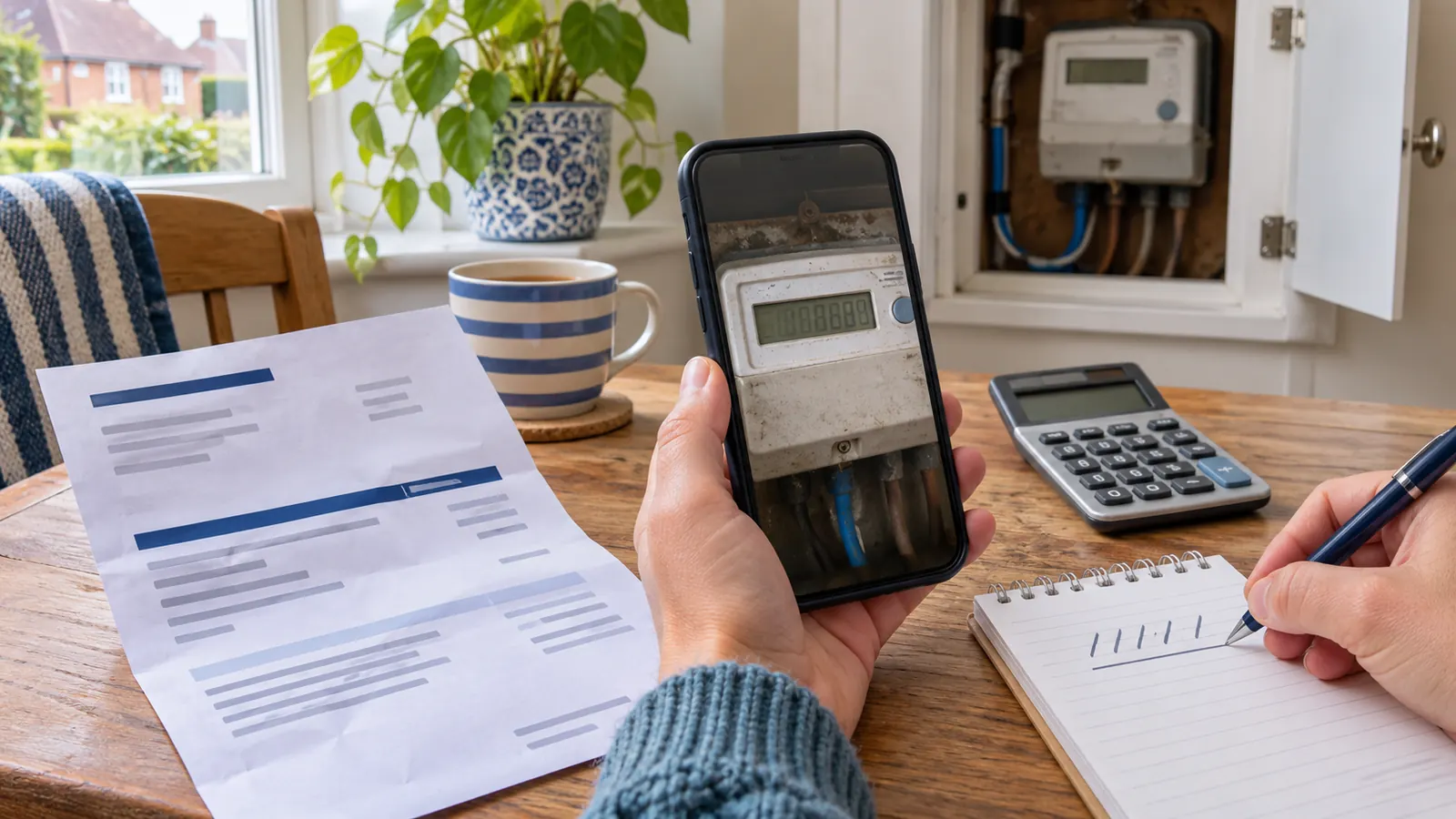
First, take a clear photograph showing the meter display. Include the meter serial number in another photograph if it does not fit in the same frame. Note the date and time. For Economy 7 or another multi-rate tariff, record every billing register and keep the labels shown on the meter; do not assume Rate 1 is always day or night.
Submit the reading through the supplier’s website, app, telephone service or another official channel. Save the receipt, screenshot or call reference. If the supplier rejects the figure as unexpectedly high or low, check for a transposed digit, the wrong meter, a decimal that should have been ignored or a missing second register, then send a fresh photograph.
Ask for a revised bill based on the accepted reading. Check that its closing reading now matches, that the previous confirmed reading has not changed without explanation, and that the unit rate and standing charge match your tariff. If you pay by Direct Debit, remember that a corrected bill balance and the monthly payment are different: the supplier may review the payment separately.
- Do not send the number on the in-home display instead of the meter reading.
- Do not combine the day and night registers on a two-rate meter.
- Keep paying an affordable undisputed amount while a billing complaint is investigated.
Check the revised calculation yourself
For a single-rate meter, subtract the previous confirmed reading from the new reading. Multiply the result by the unit rate. Then multiply the number of billing days by the daily standing charge and add the two amounts. Apply any discounts or account adjustments shown on the bill.
Suppose the previous confirmed reading was 12,480 kWh and the new reading is 12,710 kWh. Consumption is 230 kWh. At a hypothetical 25p per kWh, the usage charge is £57.50. If the period covers 30 days at a hypothetical 50p standing charge, add £15.00. The electricity charge is £72.50 before account credits, payments or other adjustments.
If the estimated closing reading was 12,820 kWh, it overstated this period by 110 kWh. At the same hypothetical unit rate, that is £27.50 of usage. The supplier should recalculate the account from the accepted reading rather than simply subtracting £27.50, because the correction may affect more than one billing period or rate.
What if the actual reading creates a catch-up bill?
A higher bill after an actual reading does not necessarily mean the new bill is wrong. If earlier estimates were below the meter’s true progress, the revised account includes electricity already used but not fully charged. Check the dates, readings and tariff before agreeing the balance.
In Great Britain, Ofgem’s back-billing rules can prevent a supplier charging a household for energy used more than 12 months ago when it had not previously billed accurately or told the customer what was due. The protection can be lost if the customer acted unreasonably, for example by blocking meter access or ignoring payment requests. The rule does not erase accurate recent charges.
If the corrected amount is valid but unaffordable, contact the supplier promptly and ask for a payment plan based on what you can afford. Explain income, essential spending and any vulnerability. Do not let fear of a catch-up bill stop you providing readings: continuing estimates can make the eventual correction harder to manage.
Smart meters and repeated estimated bills
A smart meter can keep measuring correctly when communications fail. Take a manual reading and report the estimate while the supplier investigates. If the meter display is blank, frozen or implausible, report a possible meter fault rather than only a communications problem. Keep dated photographs and bills.
Escalate a bill the supplier will not correct
Write to the supplier’s complaints team. State the reading on the estimated bill, the actual reading, the date it was taken and the correction you want. Attach photographs, submission receipts and the relevant bills. Ask the supplier to explain any reading it refuses and to pause disputed collection activity while it investigates.
For a Great Britain account, an unresolved complaint can go to the Energy Ombudsman after eight weeks or sooner if the supplier sends a deadlock letter. Northern Ireland has a separate market: NIE Networks reads electricity meters and passes readings to suppliers, and supplier licence conditions allow an estimate when no actual or acceptable customer reading is available. Ask the supplier for an updated bill after providing a reading; the Consumer Council can help with an unresolved Northern Ireland complaint.
Estimated electricity bill FAQs
Do I have to pay an estimated electricity bill?
Do not ignore it. Submit an up-to-date reading and ask for a revised bill. Pay any amount you agree is due or arrange an affordable payment while a genuine dispute is investigated.
Why is my smart-meter bill estimated?
The meter may still record electricity correctly but no longer send readings to the supplier, or the supplier may lack usable data for the period. Give a manual meter reading and ask the supplier to investigate the communication problem.
Can an estimated bill be lower than the real amount?
Yes. When repeated estimates are too low, an actual reading can produce a catch-up bill for electricity already used. Check the calculation and ask for an affordable payment plan if the valid balance is difficult to pay.
How often should I submit an electricity meter reading?
A monthly reading is a useful routine if your meter does not send readings automatically. Also take one when moving home, switching supplier or changing tariff, and keep a dated photograph.
Estimate your electricity bill
Use the electricity bill calculator with your latest and previous confirmed readings to estimate the usage charge. Add the standing charge for the billing days, then compare that result with the supplier’s revised bill.
Sources
Estimated-bill, meter-reading, smart-meter, back-billing and complaint guidance was checked against these sources on 5 November 2026:
- Citizens Advice: If you think you have been charged too much for energy
- Citizens Advice: How to read your gas or electricity meter
- Ofgem: What to do if you get a back bill
- Ofgem: Get help with your smart meter
- Ofgem: Complain about your energy supplier or network operator
- Utility Regulator: Power NI electricity supply licence