
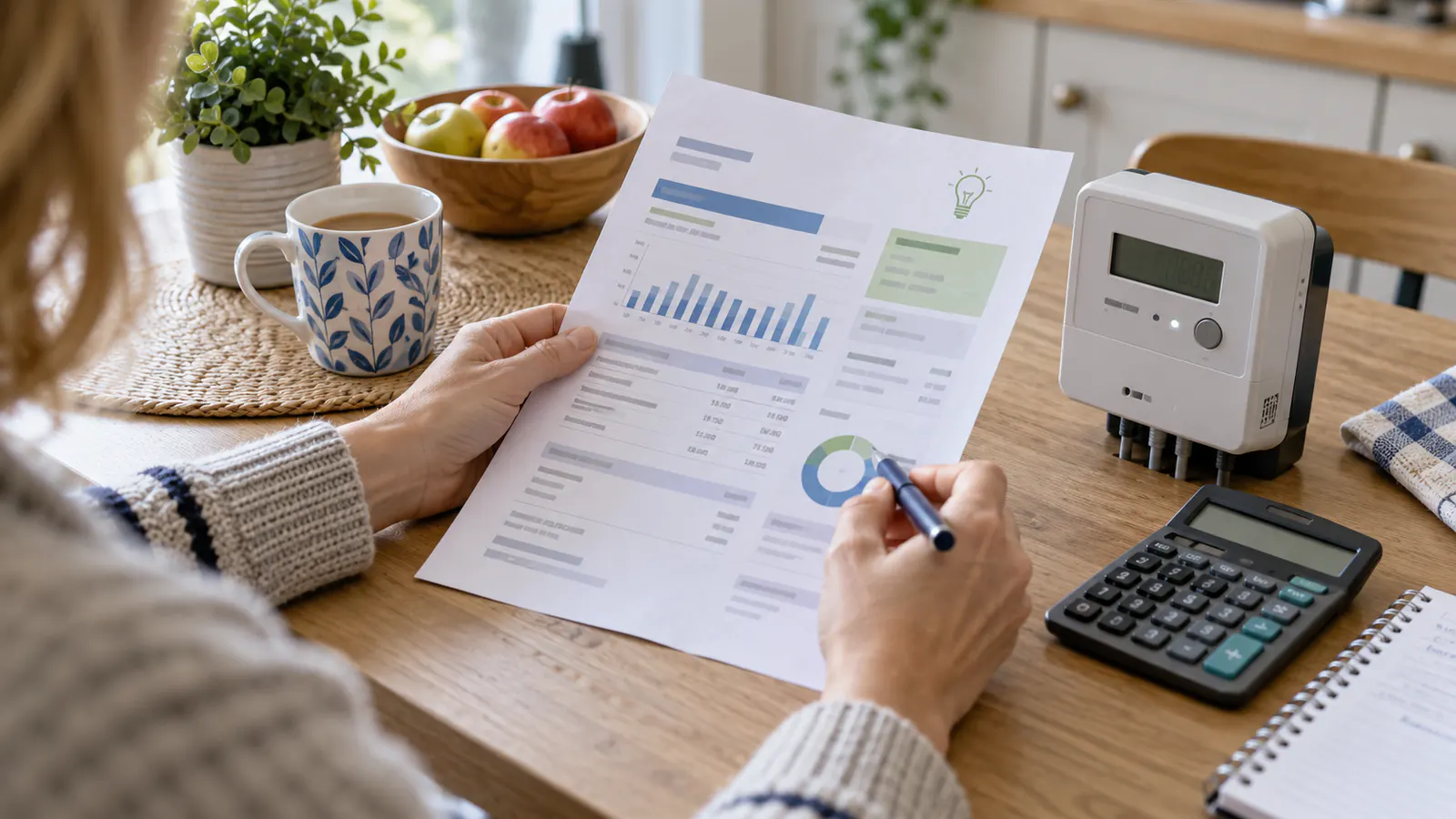
Start with the bill period and account details
A statement can contain several different dates. Find the billing period first: these are the days for which usage and standing charges are being calculated. The issue date is simply when the statement was produced, while a payment due date tells you when money must reach the supplier. A tariff end date belongs to your contract and is not the end of the billing period.
Check the name, supply address and electricity account number. In Great Britain, the bill should also identify the electricity supply with an MPAN, sometimes called the supply number. Do not confuse that long reference with the shorter serial number printed on the physical meter. If the serial number or supply address does not match, contact the supplier before relying on the usage calculation.
- Billing period: the dates covered by this calculation.
- Issue and due dates: when the bill was produced and when payment is required.
- Meter serial number: should match the number on the physical meter.
- MPAN or supply number: identifies the Great Britain electricity connection, not a meter reading.
Check whether the meter readings are actual or estimated
The bill should show an opening reading and a closing reading for the period. Suppliers use different labels, but A, C or S can indicate an actual, customer or smart reading, while E commonly means estimated. The Northern Ireland Consumer Council specifically advises that an E beside a reading means usage has been estimated. Read the legend on your own bill because abbreviations can vary.
Subtract the opening reading from the closing reading to check the billed usage in kilowatt-hours. For example, a reading that moves from 18,420 to 18,670 represents 250 kWh. With Economy 7 or another multi-rate tariff, there will be two or more registers. Check each register separately and make sure the supplier has not swapped the peak and off-peak readings.
An estimated reading is not automatically wrong, but it can make the balance drift away from reality. Compare it with the current meter, submit an actual reading if needed and keep a dated photograph. A smart meter can still produce an estimated bill if it has stopped sending readings.
Understand unit rates and standing charges
The unit rate is the price for each kWh used. It is normally shown in pence per kWh. Multiply the billed kWh by this rate, then divide by 100 to convert pence to pounds. On a multi-rate tariff, calculate each register at its matching rate and add the results.
The standing charge is a fixed daily amount, shown in pence per day, that applies even on a day when no electricity is used. Multiply the daily rate by the number of billed days and divide by 100. Count the dates carefully: a 30-day bill should normally contain 30 daily charges, unless the statement explains an adjustment.
Your Tariff Information Label summarises the tariff name, type, payment method, unit rates, standing charge, end date and any exit fee. Ofgem says suppliers must provide this label free of charge. Use it to confirm that the rates on the bill match the contract for the dates concerned.
Worked example: calculate the electricity charge
Suppose a 30-day bill shows 250 kWh used, an illustrative unit rate of 26p per kWh and a standing charge of 55p per day. Usage costs 250 × £0.26 = £65.00. The standing charge costs 30 × £0.55 = £16.50. The electricity charge is therefore £81.50 before any separate adjustment, discount or tax shown on the statement.
These rates are examples, not today’s national tariff. Use the exact prices on your bill because they vary by tariff, region, payment method and meter. From 1 October 2026, the government removed VAT from domestic electricity in Great Britain and said suppliers should apply the change automatically, including to fixed tariffs. Check the tax line rather than adding VAT yourself; Northern Ireland has a separate market and support arrangements.
- Usage: 250 kWh × 26p = 6,500p, or £65.00.
- Standing charge: 30 days × 55p = 1,650p, or £16.50.
- Illustrative electricity charge: £65.00 + £16.50 = £81.50.
Separate the energy charge from payments and balance
The amount charged for this period is not always the amount taken by Direct Debit. A fixed monthly Direct Debit spreads estimated annual costs across the year, so it may be higher than summer usage and lower than winter usage. Ofgem explains that paying more than you use can build account credit, often during summer, which can help cover higher winter charges.
Reconcile the account like a bank statement: start with the previous balance, add new charges, subtract payments and credits, then compare the result with the closing balance. If the bill says you are in credit, Citizens Advice says the supplier owes you money. If it says you are in debit, you owe the supplier, subject to any disputed or incorrect charge.
Also look for one-off items such as a refund, Warm Home Discount, compensation, debt repayment or correction from an earlier bill. These can change the account balance without changing the number of kWh used in the current period.
A five-minute electricity bill check
A quick, repeatable check is more useful than trying to decode every supplier-specific label. Work from physical facts towards money: confirm the meter, readings and usage first, then the prices, payments and balance. Compare with the previous statement so a changed rate, estimated reading or missing payment is obvious.
Use the electricity bill calculator with the same two readings and tariff prices. Its estimate should be close to the supplier’s electricity charge when both cover the same dates and registers. Investigate differences rather than forcing the calculator to match a balance that includes earlier credit, debt or unrelated adjustments.
- Match the address, meter serial number and supply details.
- Check the dates and whether each reading is actual or estimated.
- Recalculate every register in kWh at the correct unit rate.
- Multiply the standing charge by the billed days once, not once per register.
- Trace every payment, credit and adjustment into the closing balance.
What to do if the bill looks wrong
First photograph the current meter reading and serial number. Mark the exact line you dispute and send the supplier the bill, your calculation and supporting readings. Citizens Advice recommends checking changed rates, estimated readings and whether the MPAN and meter are correct when a bill seems too high.
Ask the supplier to explain the calculation and issue a corrected bill where necessary. Keep copies of messages and note when you made a formal complaint. In Great Britain, an unresolved complaint can normally go to the Energy Ombudsman after eight weeks or when the supplier issues a deadlock letter. Northern Ireland customers should follow the supplier’s process and can ask the Consumer Council for help.
If the bill is unaffordable, contact the supplier promptly even while disputing an error. Agree how to handle the undisputed current usage and ask about an affordable repayment plan. Do not ignore the statement or assume that cancelling a Direct Debit corrects the underlying account.
Electricity bill FAQs
What does CR mean on an electricity bill?
CR usually means credit: after the charges and payments shown, the supplier owes that amount to the account. Check the supplier’s own legend because statement layouts vary, and consider upcoming winter use before requesting a refund.
Why is my electricity bill higher than my Direct Debit?
The bill records the electricity charged for a period, while a fixed Direct Debit is a regular payment towards the account. High seasonal use, an estimated reading, a price change or an earlier debit balance can make the charge and payment differ.
How do I know if an electricity bill is estimated?
Look beside the opening and closing readings for E or the word estimated, and check the bill’s legend. Compare the closing figure with the physical meter and submit a current reading if it is materially different.
Where is the MPAN on an electricity bill?
In Great Britain, the MPAN may be labelled supply number and is often shown as a multi-part number or grid. It identifies the electricity connection and is different from the account number, meter serial number and the reading itself.
Should I add VAT when checking my electricity bill?
Use the VAT or tax treatment printed on the bill and do not add tax to a rate that is already inclusive. From 1 October 2026 the government removed VAT from domestic electricity in Great Britain; Northern Ireland arrangements are separate.
Estimate your electricity bill
Enter the opening and closing meter readings, exact unit rate and standing charge shown on your tariff. Compare the result with the electricity-charge section of the bill before payments, credit or debt are applied.
Sources
Billing terms, calculation steps, estimated-reading checks, current Great Britain VAT treatment and Northern Ireland guidance were checked against these sources on 3 October 2026: