

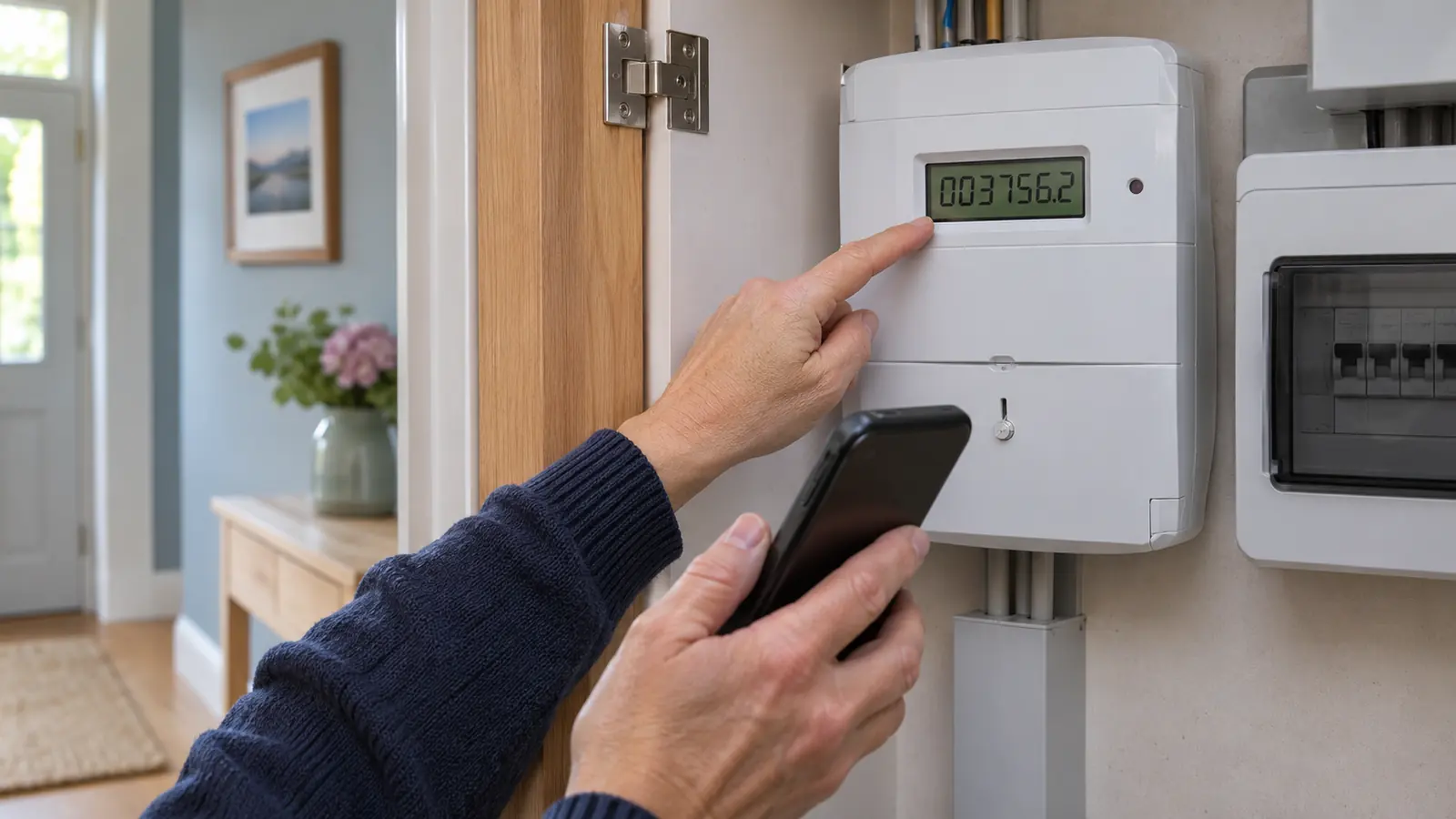
Signs of a faulty electricity meter — and common lookalikes
A blank screen, an error message, readings that do not advance while electricity is being used, or a meter that keeps recording unexpectedly can justify a supplier investigation. A sudden bill increase can also be a warning, but it is not proof of a fault. Meter faults are uncommon, and billing or household changes often explain the difference.
Check whether the bill uses an estimated reading, marked with an E or described as estimated. Compare its closing reading with the physical meter and make sure the serial number on the bill matches the number on the meter. Also check the billing dates, unit rate, standing charge and every register on an Economy 7 or other multi-rate meter.
Think about recent changes such as electric heating, an immersion-heater timer, an electric vehicle, guests or a new tariff. If a smart meter has stopped sending automatic readings but its display still records usage correctly, that is usually a communications problem rather than an accuracy fault. Submit manual readings while the supplier investigates.
Make safe checks and preserve evidence
Take clear, dated photographs of the reading, serial number and any error message. Record readings at the same time each day for about a week if it is safe and practical. Keep the bills that first showed the problem and note any appliance, solar, battery or electric-heating changes that could affect the pattern.
For a standard credit meter, Citizens Advice suggests switching ordinary appliances off and checking whether the meter continues to advance. Only do this using normal appliance controls, and remember that fixed equipment, storage heating, solar generation or a home battery can complicate the result. Do not remove covers, touch seals, pull fuses or work on wiring. Restore anything you safely switched off after the check.
Treat scorch marks, burning smells, exposed wires, a damaged case or broken seals as a safety issue rather than a home experiment. Contact the supplier promptly and keep away from the equipment. Ofgem warns that tampering is illegal and can cause fire or electric shock; damage can also be mistaken for deliberate interference, so let the supplier investigate.
- Photograph the reading and meter serial number before any visit or replacement.
- Compare actual readings, not only Direct Debit amounts or the account balance.
- Write down dates, error messages and who you spoke to at the supplier.
- Never open, alter or attempt to repair the meter yourself.
Report the meter and ask the supplier to investigate
Your electricity supplier is the first contact in Great Britain because it is responsible for arranging an investigation. Give it the account number, meter serial number, current reading, the date you noticed the problem and your photographs or reading log. Say clearly whether the issue is accuracy, a blank display, loss of supply or a prepayment fault.
For a suspected credit-meter fault in England, Scotland or Wales, Citizens Advice says the supplier has five working days from notification to investigate, take action to help fix the problem and offer to confirm what it has done and the expected timetable in writing. If it misses those steps, the current guaranteed-standard payment is £40, due within 10 working days; a late payment can trigger another £40.
A prepayment fault that prevents top-up or has already cut the supply is more urgent. Use the supplier’s emergency contact rather than waiting for an ordinary billing reply. If neighbours have also lost electricity, it is more likely to be a network power cut: contact the local network operator or call 105 in Great Britain.
How an electricity meter accuracy test works
The supplier may first ask for seven days of readings or install a check meter to compare usage. Ask what the initial investigation involves, whether there is any charge and how the supplier will protect your billing position while the dispute is open. Take a final photograph immediately before any meter is removed.
If the supplier does not resolve a genuine accuracy dispute in England, Scotland or Wales, you have the right to request an independent test. An independent examiner checks the meter at the property with a supplier representative present. The supplier then fits a replacement, and the disputed meter is taken to an approved laboratory. The examiner sends a formal determination stating whether it was within legal limits and, where possible, how long any inaccuracy existed.
The independent test itself is free, but GOV.UK warns that the supplier may charge for organising removal and replacement if the meter is found accurate. Citizens Advice says this might be around £200, but the amount varies. Get the supplier’s actual charge in writing before proceeding; do not present the example figure as a fixed fee.
Correcting the bill after a faulty-meter finding
If the meter is inaccurate, the supplier should replace it and recalculate the affected bills. The determination may estimate the percentage error and when it began. Ask for a written schedule showing the old recorded kWh, the corrected kWh, every tariff rate used and the resulting credit or debit.
For example, suppose the disputed meter recorded 2,400 kWh and the accepted correction says it was reading 15% fast. Corrected usage would be 2,400 × 0.85 = 2,040 kWh, a reduction of 360 kWh. At an illustrative 27p per kWh, the usage correction would be 360 × £0.27 = £97.20. Use the rates that actually applied to each billing period; standing charges are normally separate from the metered kWh.
An overcharge should be refunded or credited. If corrected usage produces an undercharge, the supplier may seek payment, but Great Britain’s back-billing protections can limit how far charges go back when the supplier failed to bill accurately and the customer did not obstruct accurate billing. Check the specific facts rather than assuming every correction is capped automatically, and ask for an affordable repayment plan if needed.
Northern Ireland and unresolved complaints
The Great Britain OPSS testing guidance and Ofgem guaranteed standards do not apply in Northern Ireland. The Consumer Council states that NIE Networks owns Northern Ireland’s credit and keypad electricity meters and checks that they remain safe and accurate. Report a suspected problem to your electricity supplier first; it can coordinate the metering process with NIE Networks.
Keep the same evidence: dated readings, meter serial number, bills, photographs and a written description of the fault. If the supplier does not resolve the issue, use its formal complaint process and then ask the Consumer Council for Northern Ireland for help. Do not quote Great Britain’s five-working-day rule or independent OPSS route as if it were a Northern Ireland entitlement.
In Great Britain, make a formal complaint if the supplier refuses to investigate, disputes the correction or applies an unexplained charge. Keep paying undisputed current usage where possible. You can take an unresolved complaint to the Energy Ombudsman after eight weeks or sooner if the supplier issues a deadlock letter.
Faulty electricity meter FAQs
Can a faulty electricity meter make a bill too high?
Yes, an inaccurate meter can over-record usage, but estimated readings, changed prices, the wrong meter serial number and higher household use are more common explanations. Compare the bill with dated actual readings before requesting a formal test.
Who pays for an electricity meter accuracy test?
In England, Scotland and Wales, the independent test is free, but the supplier may charge for arranging removal and replacement if the meter proves accurate. Ask for the supplier’s exact potential charge in writing first. Northern Ireland uses a separate process.
Should I stop paying while the meter is disputed?
Do not ignore the account. Tell the supplier exactly what you dispute, provide readings and ask how to pay for undisputed current usage while the investigation continues. Request an affordable plan if the amount is not manageable.
Is a smart meter faulty if it stops sending readings?
Not necessarily. The measuring part can still record accurately while communications fail. Check the physical meter, submit manual readings and ask the supplier to investigate smart mode; a blank or erroring meter needs a fault report.
Estimate your electricity bill
Use the electricity bill calculator with actual opening and closing readings, the dates covered and your tariff rates. It will not diagnose a meter, but it can show whether the disputed amount comes from the recorded kWh, prices, standing charges or account balance.
Sources
The meter-check, testing, safety and complaint steps were checked against these official and consumer-advice sources on 2 November 2026:
- Citizens Advice: Check if your energy meter is not working properly
- GOV.UK: Electricity meters — independent testing of accuracy
- GOV.UK: National regulation of gas and electricity meters
- Ofgem: What to do if you suspect meter tampering
- Consumer Council: Bills and metering in Northern Ireland
- Consumer Council: Electricity, oil and gas complaints