

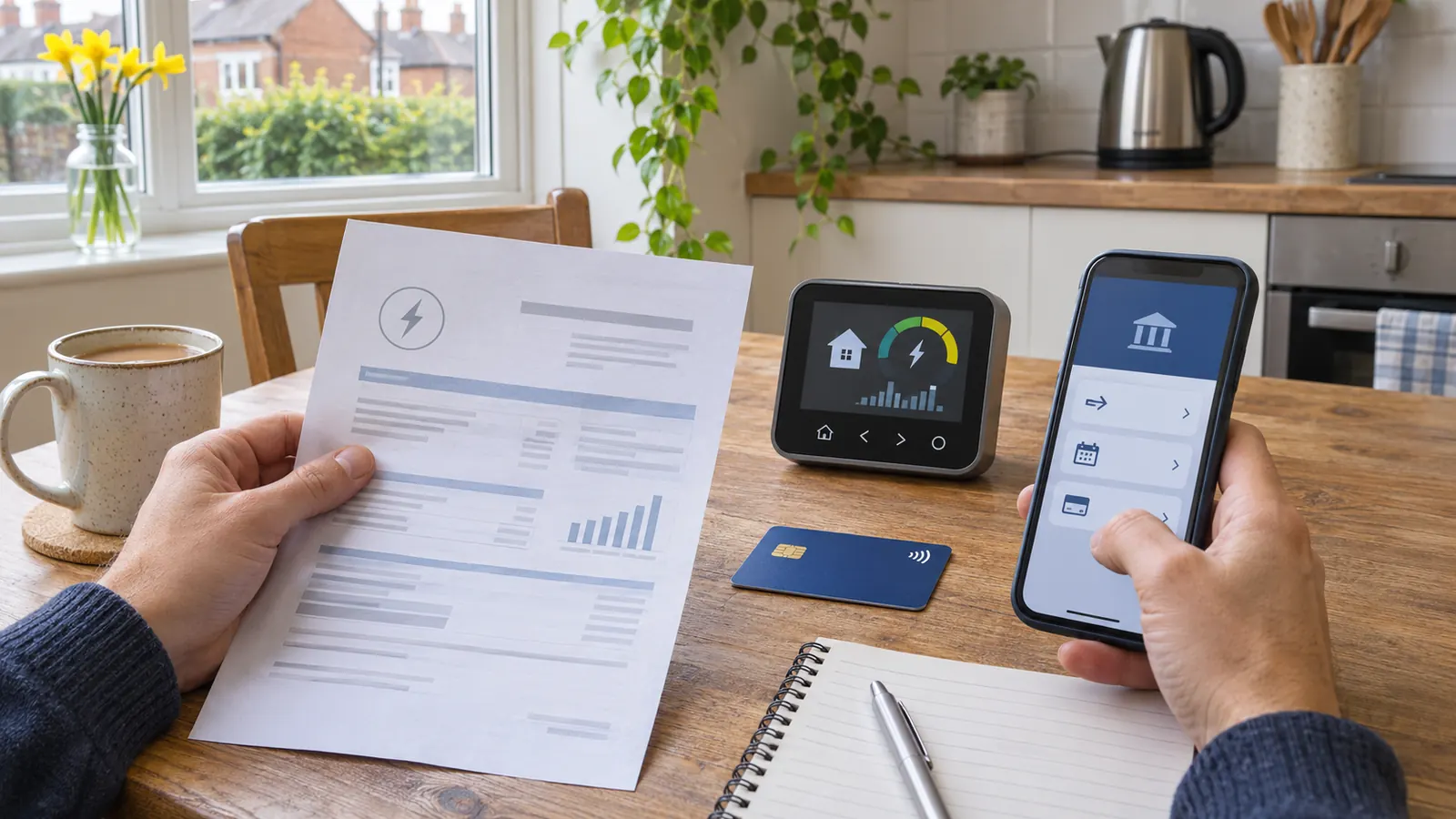
What are the main electricity payment methods?
Ofgem groups household payment methods in Great Britain into Direct Debit, standard credit and prepayment. Direct Debit takes money automatically from a bank account. Standard credit means paying after the supplier issues a bill, usually by card, bank transfer, cash or another accepted method. Prepayment means buying credit before using electricity through a key, card or smart-meter account.
A payment method is not the same as a tariff. Fixed, standard variable and time-of-use tariffs describe how prices are set; Direct Debit, standard credit and prepayment describe when and how you pay. Suppliers can quote different unit rates and standing charges for different payment methods, so two customers using the same number of kilowatt-hours can pay different amounts.
The Ofgem energy price cap covers default tariffs paid by all three main methods in England, Scotland and Wales, but it does not make their rates identical and it does not cap the final bill. Northern Ireland has a separate electricity market. Its Consumer Council recommends comparing supplier, tariff, billing method and payment method together.
| Method | When money leaves you | Main budgeting feature |
|---|---|---|
| Fixed Direct Debit | A set amount, usually monthly | Spreads forecast annual cost across the year |
| Variable Direct Debit | After each bill for the billed amount | Tracks billed use but payments can vary |
| Standard credit | You make a payment after receiving a bill | More control over timing, but manual action is needed |
| Prepayment | Before use, when you top up | Immediate control, but credit can run out |
Paying by Direct Debit
A fixed monthly Direct Debit is usually based on forecast annual use, divided into regular payments. It can smooth winter costs by building credit in lower-use months and using that balance later. The payment is not the bill itself: check statements to see the actual kWh, tariff charges and account balance. A low monthly amount can still leave a debt if the forecast is too optimistic.
Some suppliers also offer variable Direct Debit, where they collect the amount on each bill. This follows billed use more closely, but winter payments can be much larger than summer payments. Ask which type is being offered and how often the supplier reviews a fixed amount.
Direct Debit can come with lower rates or a wider choice of tariffs, but never assume it is cheapest. Compare the unit rate and standing charge with prepayment and pay-on-receipt quotes. If the supplier changes the amount, check the annual-use forecast, recent meter readings, existing credit or debt and the period over which any shortfall is being recovered.
Paying after you receive a bill
Standard credit lets you use electricity first and then pay the bill yourself. The supplier may accept a debit card, bank transfer, cash through an approved outlet or another method listed on the statement. Billing may be monthly or quarterly, so check the due date and do not confuse an estimated bill with actual consumption.
This method can suit someone who wants to inspect each bill before paying or cannot use Direct Debit. The trade-off is that standard-credit tariffs can cost more, and a quarterly bill can create a large single payment. Set money aside regularly and provide meter readings if the supplier is not receiving smart readings.
Paying manually does not give a right to withhold an undisputed bill indefinitely. If a reading or charge is wrong, contact the supplier with evidence and ask for a corrected statement. If the valid amount is unaffordable, ask for a payment plan based on what you can afford rather than letting missed bills accumulate.
Paying in advance by prepayment
A traditional prepayment meter uses a key or card, while a smart prepayment meter can usually be topped up online, in an app or at a physical outlet. You see the remaining credit and pay close to the time electricity is used, which can make short-term budgeting clearer.
You still pay the daily standing charge when no electricity is used. Citizens Advice warns that unpaid standing charges can be taken from the next top-up, leaving less usable credit than expected. Keep a physical top-up route available in case an app or mobile connection fails, and learn how emergency or friendly-hours credit works before you need it.
Prepayment is not automatically the expensive option. Citizens Advice says that, for the current Great Britain standard variable tariff, prepayment unit rates are lower than paying by Direct Debit or on receipt of a bill, with the same standing charge as Direct Debit. That relationship can change with a new price-cap period or a supplier offer, so check live rates rather than relying on a general rule.
Prepayment is a poor fit if reaching or topping up the meter is difficult, or losing supply would create a serious health risk. Tell the supplier about any disability, medical equipment or other vulnerability. Ask about a different payment arrangement and the Priority Services Register where relevant.
Worked example: compare the full monthly cost
Suppose a household expects to use 250 kWh in a 30-day month. One illustrative quote charges 26.5p per kWh and 55p a day by Direct Debit. The usage charge is 250 × 26.5p = £66.25, and the standing charge is 30 × 55p = £16.50, giving £82.75.
A pay-on-receipt quote at 28p per kWh and 60p a day would cost £70.00 plus £18.00, or £88.00. An illustrative prepayment quote at 25.5p per kWh and 55p a day would cost £63.75 plus £16.50, or £80.25. These are deliberately hypothetical rates, not current national prices.
Run the same calculation with the actual rates on each tariff quote. Then consider cash flow: a fixed Direct Debit may collect a different amount because it spreads estimated annual costs, while prepayment requires enough credit before use. Keep refundable deposits and old account balances outside the tariff comparison.
How to change the way you pay
Contact the supplier and ask for every payment option available on your current tariff and on alternative tariffs. Request the unit rate, standing charge, contract length, exit fee, billing frequency and any payment-method discount in writing. If you have a smart meter, a switch between prepayment and credit may be possible remotely; an older meter may need replacing.
The supplier may carry out a credit check or ask for a reasonable deposit before moving from prepayment to credit. Debt can also affect the available options. Do not cancel an existing Direct Debit or stop topping up until the supplier confirms the new method, tariff and start date.
Take a meter reading and photograph the meter, serial number and any prepayment balance on the change date. Check the first statement for the correct opening reading, carried-forward credit or debt, rates and payment method. Challenge discrepancies promptly through the supplier’s complaints process.
Use the same readings and billing dates for both offers. Change the unit rate and standing charge for the second calculation, then compare the totals. Add any exit fee separately; future variable rates are unknown.
Compare your rates in the electricity bill calculatorPayment methods in Northern Ireland
Northern Ireland electricity is regulated separately from Great Britain, so Ofgem price-cap comparisons do not apply. The Consumer Council lists Pay As You Go, Direct Debit and quarterly billing as common choices and publishes tariff tables showing the payment and billing method for each offer.
Discounts can depend on both payment and billing choices, such as Direct Debit combined with online billing. Compare the effective unit rate, any standing charge, discount limits and annual estimate rather than assuming that a familiar method carries the same price across suppliers.
If payments become difficult, contact the supplier early. The Utility Regulator says suppliers must consider personal circumstances and ability to pay when arranging debt repayment, and customers can ask for a revised plan if an existing arrangement becomes unaffordable.
Electricity payment method FAQs
Is Direct Debit always the cheapest way to pay for electricity?
No. It often unlocks competitive tariffs, but current standard-variable prepayment rates in Great Britain can be lower. Compare the exact unit rate, standing charge and contract terms for your home.
What is standard credit for electricity?
Standard credit means using electricity first and paying after the supplier issues a bill. You normally make the payment yourself rather than having it collected automatically by Direct Debit.
Can I pay an electricity bill monthly without Direct Debit?
It depends on the supplier and tariff. Some suppliers allow monthly manual payments or payment cards, while others bill standard-credit customers quarterly. Ask for the available frequency and rates before changing.
Does prepayment avoid standing charges?
No. The daily standing charge continues even when no electricity is used. If there is not enough credit, the unpaid charge can be taken when the meter is topped up again.
Will changing payment method change my tariff?
It can. A supplier may offer different rates or require a move to another tariff. Get the new unit rate, standing charge, contract term and start date in writing before agreeing.
Estimate your electricity bill
Enter the same electricity use and number of days for every option, then change only the quoted unit rate and standing charge. Compare the resulting energy cost separately from account credit, debt repayments or a refundable security deposit.
Sources
Payment-method definitions, billing differences, prepayment trade-offs and the separate Northern Ireland arrangements were checked against these sources on 19 November 2026: