
Which appliances use the most electricity?
In a home with electric heating or electric hot water, those systems are often the largest electricity users because they must create a lot of heat. Portable heaters, storage heaters, immersion heaters, electric showers and heat pumps can therefore dominate the total. Their actual consumption still depends on controls, insulation, weather and running time.
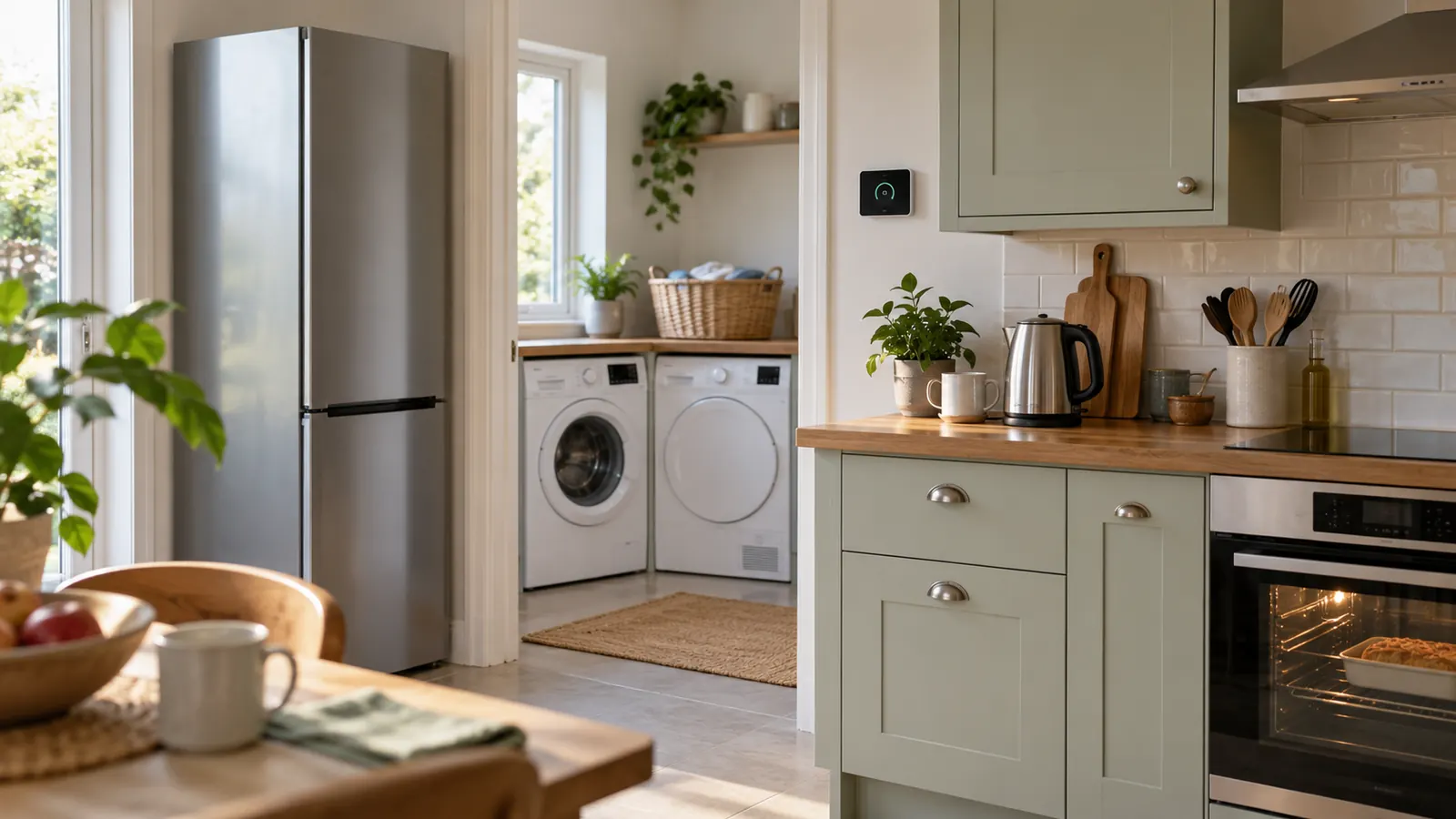
Among ordinary plug-in and kitchen appliances, tumble dryers, washing machines, dishwashers, ovens and kettles draw attention because they heat air, water or food. Fridges and freezers use less power at a time but cycle day and night. Energy Saving Trust says wet appliances account for about 14% of a typical energy bill and cold appliances about 13%, while consumer electronics account for around 6%, lighting 5% and cooking appliances 4%.
Power is not the same as energy use
Watts and kilowatts describe how quickly an appliance uses electricity. Kilowatt-hours describe the amount used over time and are what your supplier charges for. The basic calculation is: energy used (kWh) = power (kW) × time (hours). Running cost = energy used (kWh) × your unit rate.
A 3 kW kettle running for three minutes uses 0.15 kWh. At 26.32p per kWh, that is about 4p. A 100 W television used for four hours every day uses 146 kWh over a year and costs about £38.43 at the same rate. The kettle has far higher power, but the television’s long running time makes its annual use meaningful.
Electric heating, hot water and showers
Direct electric heaters and immersion heaters turn electricity into heat, so long schedules can add substantial consumption. Check thermostats and timers before assuming the equipment is faulty. Do not switch off heating, hot water, ventilation or medical equipment when doing so could harm health, cause damp or create another safety risk.
Electric showers are powerful but usually run briefly. An illustrative 9 kW shower used for ten minutes consumes 1.5 kWh and costs about 39p at 26.32p per kWh. Cutting that shower to five minutes halves the energy for that use. Citizens Advice similarly identifies electric showers as one of the most expensive household appliances to run and recommends reducing shower time where it is safe and practical.
- Use heating and hot-water timers to match occupancy and need.
- Check that an immersion-heater boost has not been left on continuously.
- If electric heating use jumps unexpectedly, compare meter readings and ask a qualified professional to check the controls.
Tumble dryers, washing machines and dishwashers
Drying clothes with heat normally uses more electricity than washing them. For illustration, a 2 kW tumble dryer averaging that draw for 90 minutes would use 3 kWh and cost about 79p at 26.32p per kWh. Real machines vary their power through a cycle, so use the energy label, manual or a plug-in monitor for a better figure.
Run full loads when suitable, use eco programmes, clean dryer filters and air-dry safely when practical. Citizens Advice warns against scheduling washing machines, tumble dryers or dishwashers while you are asleep because of fire risk. A cheaper time-of-use rate does not make unattended overnight operation a good idea.
Fridges, freezers and devices left on
Cold appliances run continuously, switching their compressor on and off to hold temperature. Their annual energy-label figure is more useful than multiplying the maximum wattage by 8,760 hours. A fridge-freezer labelled at 150 kWh a year would cost about £39.48 a year at 26.32p per kWh.
Choose a model that is no larger than you need, compare annual kWh as well as the A-to-G class, leave ventilation space and keep seals in good condition. Do not turn off a working fridge-freezer to chase a small saving: food and temperature-sensitive medicine must remain safely stored. Routers, set-top boxes and consoles use less power individually, but unnecessary standby across many devices can accumulate.
Use the energy label when buying an appliance
The A-to-G class helps compare similar products, but size matters. A larger appliance can use more electricity than a smaller model with the same rating. Energy Saving Trust advises checking the consumption figure on the label: washing machines and dishwashers show kWh per 100 eco cycles, while fridges and freezers show annual consumption.
Suppose two 10 kg washing machines are labelled at 51 kWh and 90 kWh per 100 eco cycles. At four washes a week, they would use about 106 kWh and 187 kWh a year. At 26.32p per kWh, that is approximately £27.92 versus £49.27—a £21.35 annual difference. Treat this as a like-for-like illustration; the programme, load and your rate change the result.
How to find the biggest user in your home
Begin with a recent bill and note your actual unit rate. Take a meter reading, then another at the same time a week later. During a second comparable week, change one safe habit—such as using the tumble dryer less—and compare the kWh, allowing for weather and occupancy. A smart-meter in-home display can show immediate changes, but it is not a bill and short snapshots do not reveal annual use.
For a plug-in appliance, an energy monitor can measure kWh over a representative cycle or several days. Do not use a domestic plug-in monitor for hard-wired equipment, electric showers, cookers or other loads outside its rating. For those, use manufacturer information or qualified advice.
- Copy kWh from the energy label for appliances with variable cycles.
- Use watts × hours ÷ 1,000 for a steady-load estimate.
- Multiply kWh by the unit rate on your tariff, not a national average.
- Separate peak and off-peak kWh if you have Economy 7 or another time-of-use tariff.
- Rank annual cost and realistic savings, not just headline wattage.
Where to cut use first
Prioritise changes that remove a meaningful amount of heating or running time without making the home unsafe. Shorter electric showers, correct hot-water timers, full laundry loads, fewer tumble-dryer cycles and sensible heating controls can matter more than repeatedly unplugging a phone charger.
The daily standing charge is separate from appliance consumption and continues while the property remains connected. Ofgem’s average Great Britain Direct Debit rate for 1 October to 31 December 2026 is 26.32p per kWh, with a 54.83p daily standing charge; regional and payment-method rates differ. Northern Ireland has a separate market, so use the unit rate shown on your own bill everywhere in the UK.
Household electricity use FAQs
What uses the most electricity overnight?
Electric heating, storage heaters or hot-water systems can dominate if scheduled overnight. Otherwise, fridges, freezers, routers and standby devices create the background load. A time-of-use tariff may make overnight electricity cheaper, but it does not reduce the kWh used.
Does a higher-watt appliance always cost more?
No. Cost depends on power and time. A high-power kettle used for minutes can consume less over a year than a low-power device left on for hours every day.
How do I calculate an appliance running cost?
Convert watts to kilowatts by dividing by 1,000, multiply by hours used, then multiply the resulting kWh by your electricity unit rate. For variable-cycle appliances, use labelled kWh per cycle where available.
Will reducing appliance use remove the standing charge?
No. The standing charge is a separate daily cost that normally applies while the property is connected. Using fewer kWh reduces the energy charge, not the standing charge.
Can a smart meter tell me which appliance is using electricity?
An in-home display usually shows whole-home use, not a guaranteed appliance-by-appliance breakdown. Watching it while switching one safe appliance on can indicate the change, while a suitable plug-in monitor can measure an individual plug-in device over time.
Calculate your appliance running costs
Enter watts and hours or kWh per cycle, then compare costs for different usage patterns.
Estimate your electricity bill
Use your meter readings to check the whole household, then use the appliance cost calculator for individual devices. Standing charges still apply when you reduce appliance use, so compare changes in the energy charge rather than expecting the entire bill to fall by the same amount.
Sources
Appliance rankings, energy-label guidance, safety advice and the current Great Britain comparison rate were checked against these sources on 7 October 2026:
- Energy Saving Trust: What appliances drive up electricity bills most
- Energy Saving Trust: Home appliances and energy efficiency ratings
- Citizens Advice: Save money using your electrical appliances
- Citizens Advice: Buying a more energy efficient appliance
- Ofgem: Energy price cap unit rates and standing charges