
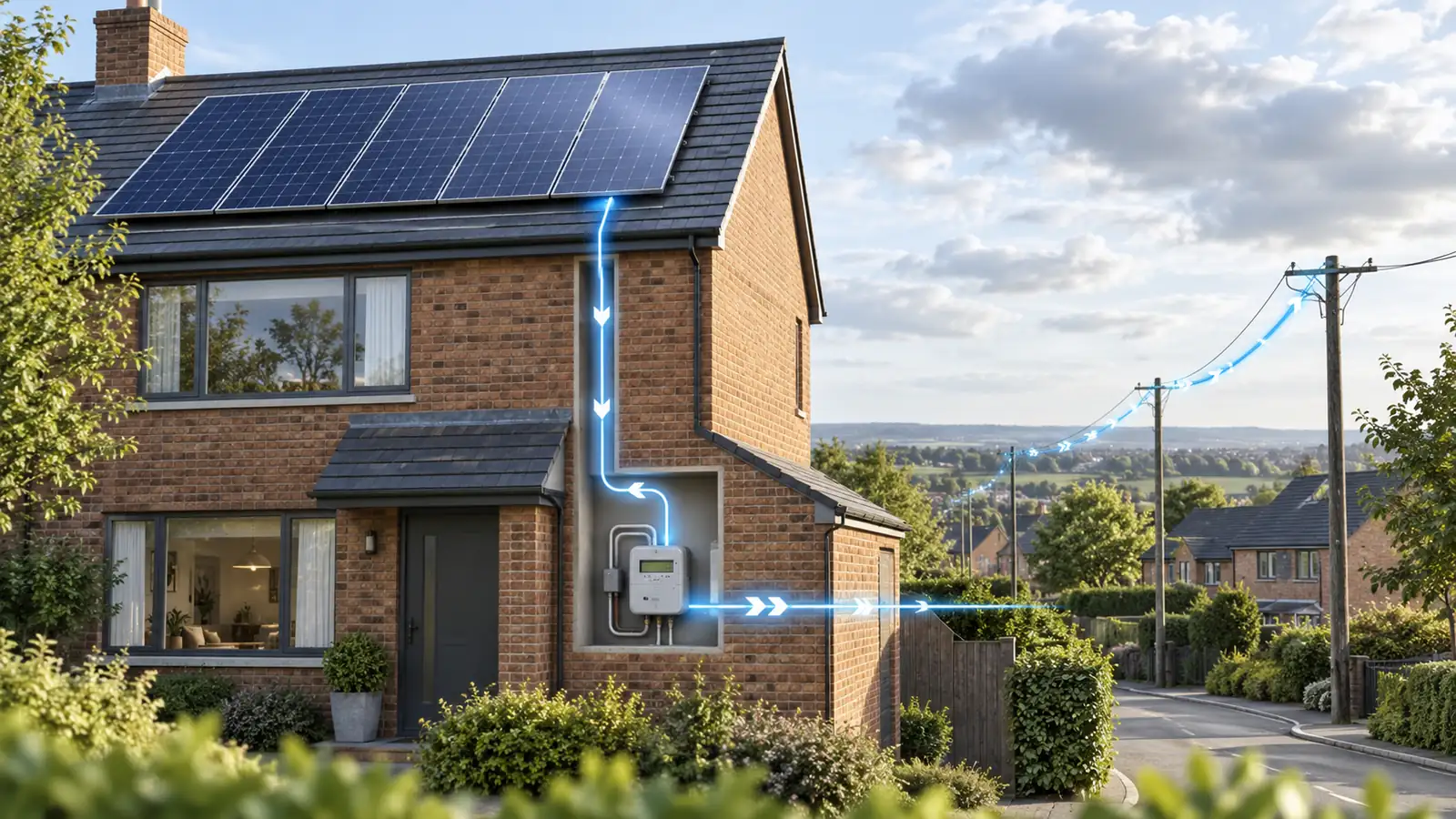
What is the Smart Export Guarantee?
The Smart Export Guarantee requires participating Great Britain suppliers to offer a tariff for eligible low-carbon electricity exported to the grid. It is an export-payment framework, not a grant towards buying solar panels or a guarantee of a particular market rate.
Ofgem says the supplier sets the rate, contract length and terms, but a compliant SEG rate must remain above zero. Payments must be available for actual metered export. Tariffs can be fixed, variable or time based.
Your export supplier does not have to supply the electricity you buy. You can have one company for SEG payments and another for your household import tariff, although some export deals offer different rates or eligibility conditions to existing import customers.
Who can apply for SEG payments?
Eligible technologies are solar photovoltaic panels, onshore wind, hydro, anaerobic digestion and micro combined heat and power. Solar, wind, hydro and anaerobic-digestion installations can have a total installed capacity of up to 5 MW; micro-CHP is limited to 50 kW.
The installation must be in England, Scotland or Wales and meet the scheme’s technical and certification rules. For installations up to 50 kW, Ofgem says applicants will normally need a Microgeneration Certification Scheme certificate or an equivalent document. Ask the chosen SEG supplier exactly what evidence it accepts before assuming an installation qualifies.
You also need a meter capable of measuring half-hourly export and registered for settlement. A suitable smart meter can often do this, but it does not enrol you automatically: the supplier must still process the application and export meter point.
- Check that the technology, location and installed capacity are eligible.
- Find the installation certificate and any ownership documents.
- Confirm that your meter can record half-hourly export.
- Apply to a SEG licensee and wait for confirmation before counting on payments.
How to calculate a Smart Export Guarantee payment
Use: SEG payment = exported electricity in kWh × export rate in pence per kWh ÷ 100. The exported kWh is not the same as everything your panels generate. Electricity used immediately in the home never reaches the grid, so it reduces imports instead of earning an export payment.
For a worked example, suppose the export meter records 1,500 kWh over a year and the tariff pays a hypothetical 12p per kWh. The payment is 1,500 × 12p = 18,000p, or £180. At a hypothetical 8p export rate, the same metered export would earn £120. That £60 difference shows why both the rate and a realistic export estimate matter.
Do not subtract the household standing charge or add it to this calculation. The standing charge belongs to the import supply bill. Also check whether the quoted export rate is fixed, variable or restricted to particular hours, because a time-based tariff may pay different rates for different half-hour periods.
Compare the whole export tariff, not one headline rate
Start with the pence-per-kWh rate, then check whether you must buy electricity from that supplier, use particular hardware, have a compatible battery or accept remote control. Note how readings and payments work and whether the rate can change.
Compare the likely annual result using the same export estimate for every offer. If you expect 1,500 kWh of export, multiply 1,500 by each applicable rate. For a time-of-use export tariff, split the expected kWh between its payment periods instead of applying the best rate to the whole year.
Energy Saving Trust warns that deals can be time limited or carry other conditions. Keep the accepted terms and check what happens if you change import supplier, add a battery or move.
- Export rate and whether it is fixed, variable or time based.
- Any requirement to take an import tariff from the same supplier.
- Meter, solar, inverter or battery compatibility conditions.
- Contract length, exit terms, payment frequency and reading method.
Is it better to use solar electricity or export it?
A self-used solar kWh avoids buying one kWh at your import rate, while an exported kWh earns the export rate. Compare those two values at the time the electricity is generated. If your import rate were a hypothetical 25p per kWh and your export rate 12p, using 300 kWh in the home would avoid £75 of imports; exporting the same 300 kWh would earn £36. The illustrative difference is £39.
Do not run appliances unnecessarily. Shift useful, flexible loads only when safe and practical. A battery can move solar electricity to later, but cost, capacity, efficiency, warranty and tariff rules affect its value.
Measure before making a large purchase. Compare generation, household use, imports and exports across seasons. Energy Saving Trust’s solar calculator can estimate savings and SEG payments, while your installer can explain any export limit imposed by the network connection.
How to apply and check the first payment
Use Ofgem’s current list of SEG licensees and apply to your chosen supplier. Be ready with the installation certificate, ownership evidence and requested meter information; the exact process varies.
Ask when the export meter point becomes active. Keep the acceptance, opening export reading and terms. Compare the first statement’s dates, export and rate with your records, and use the supplier’s complaint process if something is wrong.
Households receiving Feed-in Tariff generation payments can generally retain those generation payments, but cannot receive both FIT export payments and SEG payments for the same electricity. Ofgem says an eligible FIT generator must opt out of the FIT export element before registering for SEG export payments.
Northern Ireland uses separate export arrangements
The Smart Export Guarantee applies in Great Britain, not Northern Ireland. In Northern Ireland, a household micro-generator can sell exported electricity directly to a supplier or through an agent under separate local arrangements. Do not rely on a GB SEG comparison when estimating a Northern Ireland payment.
NIE Networks says a domestic single-phase micro-generator under the G98/NI route is typically up to 3.68 kW. The generator must be notified and registered, an import/export meter must be fitted, and a purchase contract must be in place with the chosen electricity supplier before the household can benefit from exports. The Utility Regulator says export settlement uses actual meter readings rather than the former deemed-export approach.
Smart Export Guarantee FAQs
Do I need a smart meter for the Smart Export Guarantee?
You need a meter capable of measuring export in half-hourly periods and registered for settlement. This is often a smart meter, although another compliant export meter may qualify. Ask the SEG supplier to confirm compatibility.
What is the minimum Smart Export Guarantee rate?
Ofgem requires a compliant SEG tariff rate to be above zero, but it does not set a standard minimum payment in pence per kWh. Suppliers decide their rates and terms, so compare current offers.
Can my SEG supplier be different from my electricity supplier?
Yes. Ofgem says you can choose a different SEG licensee from the company that supplies the electricity you buy, although some tariffs attach conditions or better rates to existing customers.
Can I receive both Feed-in Tariff and SEG payments?
You cannot receive FIT export payments and SEG payments for the same exported electricity. An eligible FIT generator can opt out of the FIT export element and keep FIT generation payments while receiving SEG export payments.
Does the Smart Export Guarantee apply in Northern Ireland?
No. SEG covers England, Scotland and Wales. Northern Ireland has separate supplier purchase contracts, metering and network-registration arrangements for exported microgeneration.
Estimate your electricity bill
Keep import and export calculations separate. Use the electricity bill calculator with your import meter readings, unit rate and standing charge to estimate what you buy from the grid. Calculate SEG income independently as exported kWh multiplied by the export rate.
Sources
Eligibility, metering, tariff rules, practical application steps and the Northern Ireland distinction were checked against these sources on 11 October 2026: