
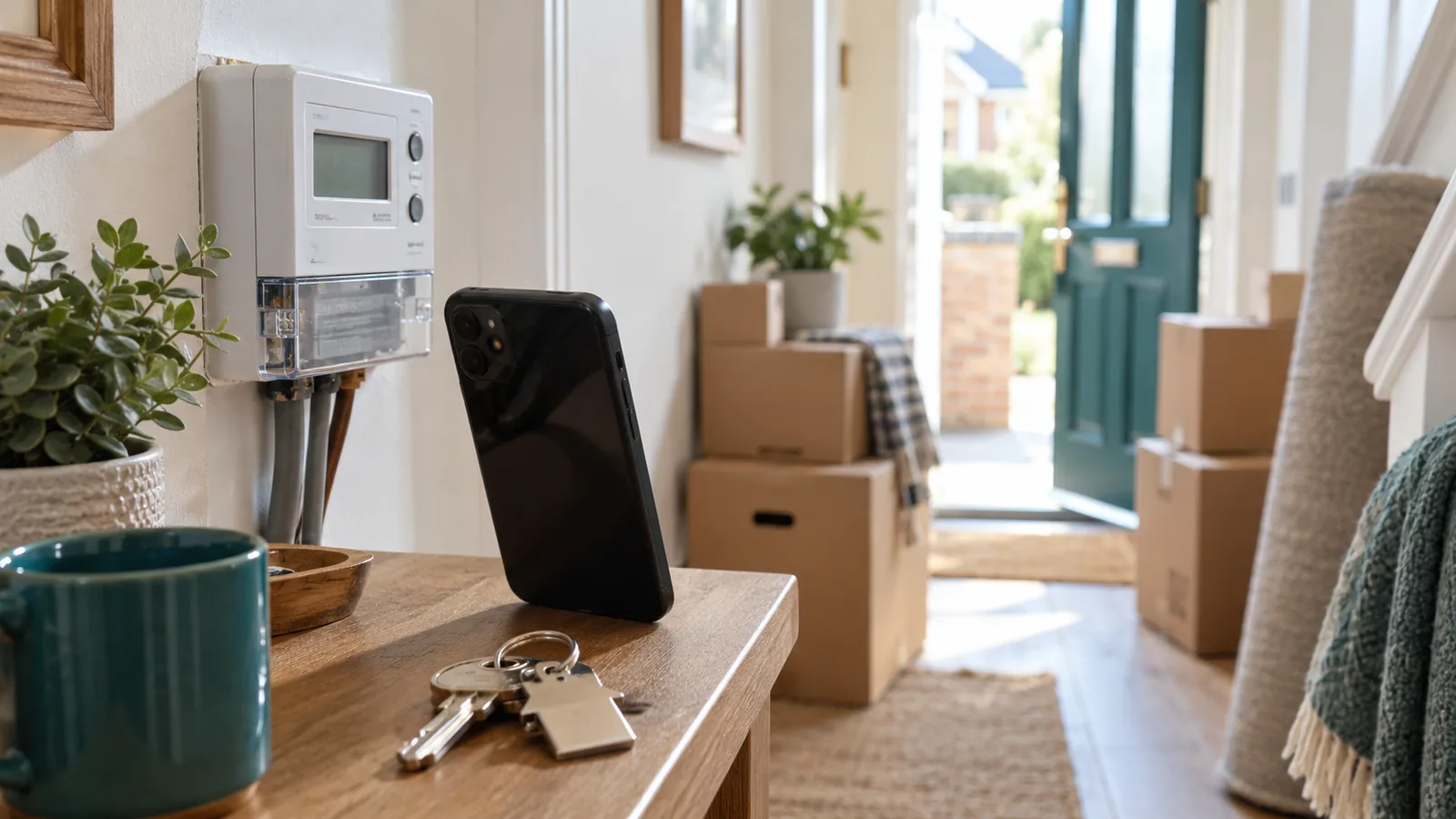
Before moving day: contact your current supplier
Tell the supplier for your old home that you are moving and confirm the date you stop being responsible for the property. Citizens Advice recommends giving at least 48 hours’ notice. Provide a forwarding postal address and an email address so the supplier can send the final bill or return any credit after the account closes.
Check whether your fixed tariff has an exit fee and whether the supplier will let you move the tariff to the new address. A tariff belongs to a supply contract, not to the meter itself, so it does not automatically follow you. Do not cancel the old Direct Debit before the final bill and any refund have been settled unless the supplier tells you to do so.
Keep the old account number, recent bill and login details. Note whether the meter is single-rate, Economy 7 or another multi-rate type, because you must record every register that contributes to the bill.
- Confirm the date your responsibility ends and give contact details.
- Check the tariff terms, including any exit fee or move-home option.
- Find the electricity meter and learn which registers must be read.
- Arrange access if the meter is in a communal or locked cupboard.
On the day you leave: take a closing meter reading
Read the electricity meter as close as practical to handing over the property. Photograph the full display and keep the original image so its date is preserved. If the meter cycles through several screens, capture the reading and meter serial number; for a two-rate meter, record both registers and label them exactly as displayed.
Send the reading to the old supplier and save its confirmation. Write down the date, reading, serial number and who you contacted. The closing reading should be the boundary between your final bill and the next occupant’s account.
Take a reading even if the meter is smart. Smart communications can fail, and a dated photograph gives you evidence if the supplier later uses an estimate. Leave the in-home display at the property: it is paired with the meter and is not the meter itself.
On arrival: identify and contact the existing supplier
At the new home, photograph the electricity meter on the day your responsibility starts. Contact the supplier already serving that address, give the opening reading and set up the account in your name. If you do not know the supplier, use the network operator’s lookup route rather than assuming your old supplier also serves the new property.
In Great Britain, using electricity before agreeing another tariff normally creates a deemed contract with the property’s existing supplier. You can choose a new tariff or supplier after you move in, but first register with the existing supplier so the opening bill starts from the right date and reading.
If you rent and pay the supplier directly, Ofgem says you can choose your supplier or tariff. Check the tenancy agreement for a default-supplier clause, a requirement to notify the landlord or agent, or a clause asking you to return the supply to a particular arrangement when you leave.
If the new home has a prepayment meter
Contact the existing supplier before using an old key or card or making a top-up if possible. Ask it to create your account, remove any previous occupant’s debt from the meter and issue the correct key, card or app setup. Otherwise, some of your top-up could be taken for debt that is not yours.
If you must top up before the account is corrected, keep the receipt and proof of the move-in date. Tell the supplier what happened and ask it to refund any amount wrongly taken for the former occupant’s debt. Record the balance and meter screens when you arrive as well as the main reading.
Check the old home’s final electricity bill
Compare the final bill with your closing photograph. Check the meter serial number, whether the reading is marked actual or estimated, the billing end date, every unit-rate register and the number of standing-charge days. Challenge the bill promptly if the reading or responsibility date is wrong.
A simple check is: final usage = closing reading − previous actual reading. Suppose the previous actual reading was 18,420 kWh and the closing reading is 18,575 kWh. The billed usage should be 155 kWh. At a hypothetical 25p per kWh, that usage costs £38.75. If the bill also includes 30 days at a hypothetical 55p standing charge, add £16.50, giving £55.25 before any other adjustments shown on the bill.
For Great Britain accounts, Citizens Advice and Ofgem say the old supplier should issue the final bill within six weeks. If the closed account is in credit, the supplier should refund it within 10 working days of sending the final bill. Keep your contact details current and follow up if either deadline is missed; compensation may be due under Ofgem’s standards.
Check the first bill at the new home
The first bill should begin on the date you became responsible and use your opening reading. It should not include the former occupant’s electricity, account debt or an earlier standing-charge period. Compare the billed meter serial number with the meter at the property, especially in flats where meters can be labelled incorrectly.
If the bill starts from an estimate, send the photograph again and ask the supplier to rebill from the recorded opening reading. Keep tenancy, completion or handover documents because they can show when responsibility changed. Do not simply deduct a disputed amount yourself: explain the error and ask for a corrected bill.
When to switch at the new address
You can compare tariffs once you are responsible for the property and the existing supplier knows you have moved in. Use annual kWh rather than a Direct Debit amount where possible, but remember that the previous occupant’s usage may not represent your household.
Ofgem says a Great Britain home switch should complete within five working days. Check unit rates, standing charges, payment method, exit fees and any time-of-use conditions rather than choosing on one headline figure. If you need electricity at night for storage heating or vehicle charging, compare the relevant peak and off-peak rates.
A Priority Services Register entry does not automatically transfer between suppliers or addresses. If anyone in the household may need additional support because of age, disability, illness or reliance on medical equipment, ask the new supplier and local network operator to register the new address.
Northern Ireland: the same readings, a separate market
Northern Ireland is not covered by Ofgem’s Great Britain price cap or switching framework. The Utility Regulator still advises households to tell the old supplier, take a final reading on move-out day, then contact the existing supplier and provide an opening reading at the new property.
Prepayment customers should tell the supplier they have moved so they do not pay a previous resident’s debt. If you want another supplier, first establish the new account and then contact the chosen supplier. Use Northern Ireland supplier and regulator guidance for local tariff, complaint and switching rules rather than assuming Great Britain deadlines apply.
Moving house electricity FAQs
Do I need to take a meter reading when moving if I have a smart meter?
Yes. Take and save dated photographs on the day you leave and the day you move in. Smart meters can stop communicating, and the photographs provide evidence if either supplier uses an estimate.
Can I take my electricity supplier with me when I move?
Your supplier may offer to move your tariff, but it does not transfer automatically. First close the old address correctly and register with the supplier already serving the new address, then choose the tariff or supplier you want.
Who pays the electricity bill between tenants?
Responsibility depends on the occupancy and tenancy arrangements. Ofgem says a landlord who pays the energy bills should deal with the supplier and pay for the supply between tenancies. Opening and closing readings help establish the correct boundary.
How long should a final electricity bill take?
For a Great Britain household account, the old supplier should issue the final bill within six weeks. If the account is in credit, it should refund the balance within 10 working days of issuing that bill.
What if the new home has someone else’s prepayment debt?
Contact the existing supplier, prove when you moved in and ask it to remove the previous occupant’s debt and provide your own top-up method. Keep receipts if you had to top up before the account was corrected.
Estimate your electricity bill
Use the closing reading from your old home with an earlier actual reading to check the final usage. Subtract the earlier reading from the closing reading, then enter that usage with the unit rate, standing charge and number of days shown on your bill.
Sources
Move-day readings, deemed-contract rules, switching times, final bills, refunds and Northern Ireland steps were checked against these sources on 10 October 2026: