

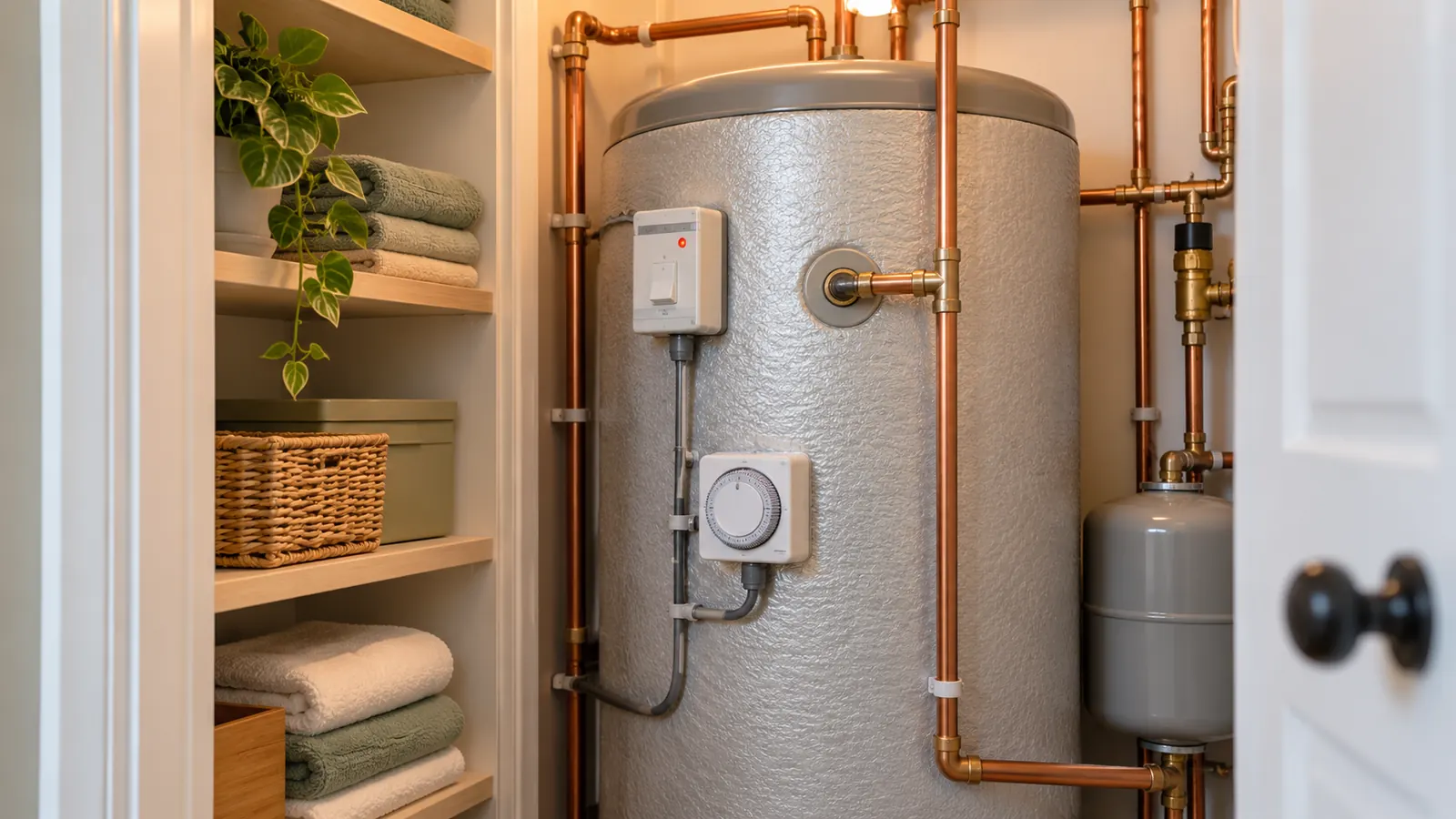
How much does an immersion heater cost to run?
For a 3 kW immersion heater, one full hour of active heating uses 3 kWh. At Ofgem’s Great Britain Direct Debit electricity comparison rate of 26.32p per kWh for 1 October to 31 December 2026, that costs 3 × £0.2632 = £0.7896, or about 79p. Half an hour of active heating uses 1.5 kWh and costs about 39p.
That rate is only a current Great Britain benchmark, not a universal tariff. Your region, payment method, fixed deal or time-of-use tariff may produce a different price. Northern Ireland has a separate electricity market. Always take the unit rate from your own bill or app, and check whether it is the peak or off-peak rate that applies.
- 30 minutes at 3 kW: 1.5 kWh; about 39p at 26.32p/kWh.
- One hour at 3 kW: 3 kWh; about 79p at 26.32p/kWh.
- Two hours at 3 kW: 6 kWh; about £1.58 at 26.32p/kWh.
- Daily 90-minute active heating: 4.5 kWh; about £1.18 a day or £432 a year at the same rate.
Use this immersion heater cost formula
The calculation is: cost = heater power in kW × active heating time in hours × electricity unit rate in pounds. Divide watts by 1,000 to convert them to kilowatts, and divide minutes by 60 to convert them to hours. If your bill shows pence per kWh, divide that number by 100 before multiplying, or keep the answer in pence.
Worked example: a 3,000 W element runs for 45 minutes on a tariff charging 24p per kWh. The power is 3 kW and the time is 0.75 hours, so energy use is 3 × 0.75 = 2.25 kWh. The cost is 2.25 × £0.24 = £0.54. If the same heating happens every day, the simple annual estimate is £0.54 × 365 = £197.10.
Treat estimates based only on timer hours as an upper-bound style calculation. Once the cylinder reaches its set temperature, the thermostat should stop the element drawing its full rated power. It may switch on again later to replace heat lost from stored water, so leaving the timer enabled for four hours does not automatically mean four hours at 3 kW.
Find the numbers for your own cylinder
Look for a rating plate, installer paperwork or the manufacturer’s instructions. Many domestic elements are rated at 3 kW, but do not assume yours is. The figure you need is electrical input power, normally shown in watts or kilowatts. Do not remove covers or touch fixed wiring to find it.
For the unit rate, use the electricity price on your tariff rather than your monthly Direct Debit. A Direct Debit is a payment towards the account, not the price of each kWh. On Economy 7 or another time-of-use tariff, identify whether the main element heats during the cheaper window and whether a separate boost element uses the dearer daytime rate.
Why timer time and heating time are different
A timer decides when the immersion heater may operate. The thermostat responds to water temperature and cycles the element. A cold cylinder may draw the full rated power for much of the first heating period; a warm, insulated cylinder may need only short top-ups. Hot-water use, incoming water temperature, cylinder size, thermostat setting and standing heat loss all change the result.
This is also why a generic “cost per hour” is not a promise about a day’s bill. It tells you the cost while the element is actively heating. The daily total is better measured in kWh. Citizens Advice’s appliance table gives about 75p an hour for an immersion heater as a broad comparison, while your own rating and tariff produce the useful household figure.
Use the timer, off-peak rate and boost correctly
Heat only the water you expect to use, at times that suit the system and tariff. Citizens Advice recommends using a timer and avoiding unnecessary boost operation. In many two-element cylinders, the lower element heats most or all of the cylinder during the off-peak period, while the upper “boost” element heats a smaller volume at the peak rate when extra hot water is needed.
Check the exact cheap-rate hours with your supplier because they depend on the tariff, meter and location and can shift with the clocks. Do not assume that every overnight hour is off-peak. If you normally use one batch of hot water, schedule heating shortly before it is needed rather than repeatedly reheating the cylinder all day.
Reduce heat loss without compromising safety
Cylinder and pipe insulation reduce the energy needed to replace heat that escapes before you use the water. Energy Saving Trust says an existing jacket should be at least 80 mm thick and estimates that adding an 80 mm British Standard jacket over a cylinder with only 25 mm of foam can save about £45 a year in Great Britain or £35 in Northern Ireland. Check the product instructions and do not cover controls or electrical fittings.
Do not turn stored-water temperatures down casually. Energy Saving Trust recommends setting a hot-water cylinder thermostat to 60°C: high enough to control harmful bacteria, but hot enough to scald. If you have a heat pump or a specialist control cycle, follow the installer’s instructions rather than overriding its schedule.
Warning signs and when to get help
Switch the immersion heater off and seek competent help if water is excessively hot, the cylinder makes unusual bubbling noises, hot water comes from a cold tap, or there is steam or moisture in the roof space. HSE identifies these as possible signs of thermostat failure and overheating, and says an independent safety cut-out can limit the temperature if the thermostat fails. Never open the electrical cover or attempt fixed-wiring work yourself; tenants should report faults promptly to their landlord.
A practical five-minute check
First, note the heater’s kW rating and your applicable unit rate. Second, check that the timer clock is correct and that automatic mode is selected rather than a permanent override. Third, identify whether “boost” uses peak-rate electricity. Fourth, inspect the cylinder jacket without disturbing wiring. Finally, record a week of meter readings and compare it with the formula. Change one setting at a time while keeping hot-water availability and safety constant.
Immersion heater running cost FAQs
Is it cheaper to leave an immersion heater on all the time?
Usually it is better to use a timer so the cylinder heats for expected demand. A thermostat prevents continuous full-power heating, but stored water still loses heat and may be reheated. The cheapest schedule depends on hot-water use, insulation and tariff.
How much electricity does a 3 kW immersion heater use in one hour?
It uses 3 kWh during one full hour of active heating. Multiply 3 by your unit rate. At 26.32p per kWh the active-heating cost is 78.96p, rounded to about 79p.
How long should an immersion heater be on?
There is no single safe and economical duration for every cylinder. Size, starting temperature, element position, insulation and demand all matter. Use the timer and thermostat as designed, start with the installer or manufacturer guidance, and adjust only while maintaining safe stored-water temperatures.
Does the standing charge belong in the running cost?
No. The standing charge is payable for having the electricity supply available and does not rise when the immersion heater runs. Include it once when estimating the whole household bill, but not when comparing the marginal cost of this appliance.
Estimate your electricity bill
Add the immersion heater’s measured kWh to the rest of your household use when checking the whole bill. Use your actual meter readings and tariff rate; the normal standing charge is paid for the property anyway and should not be assigned again to one appliance.
Sources
Running-cost, tariff, control, insulation and safety guidance was checked against these sources on 17 October 2026:
- Citizens Advice: Save money using electrical appliances
- Citizens Advice: Using storage heaters and immersion heaters
- Ofgem: Energy price cap unit rates and standing charges
- Energy Saving Trust: Insulating tanks, pipes and radiators
- Energy Saving Trust: Thermostats and heating controls
- HSE: Scalding risk from domestic hot water systems