

Estimated Electric Bills: How to Check a Catch-Up Charge
Trace an estimated electric bill back to the last actual reading, check a catch-up charge without counting usage twice, and request a clear billing correction.
By Electricity Bill Calculator · Updated
Start with the last actual reading
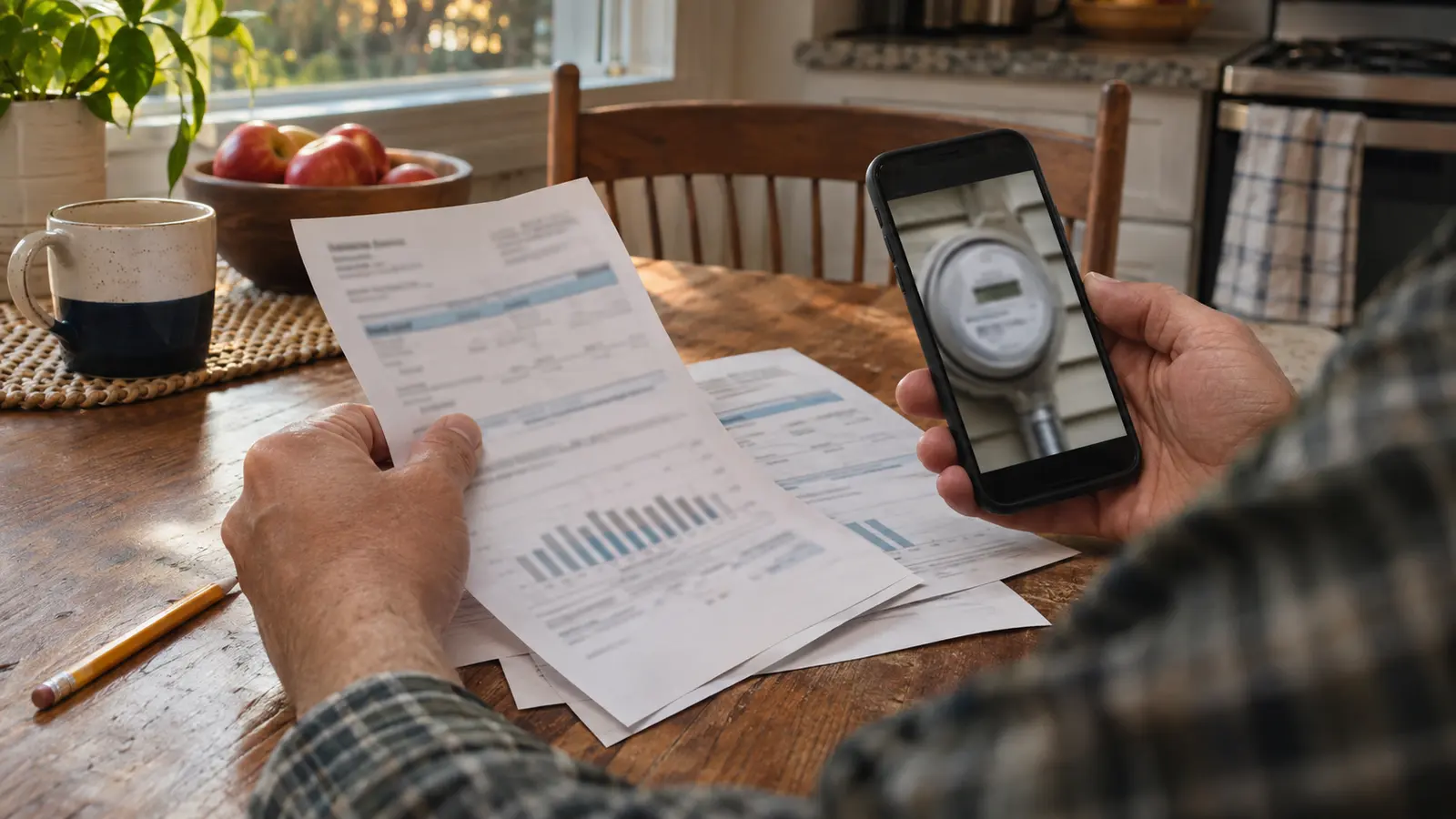
An estimated electric bill can leave some electricity unbilled until a later actual reading catches it. To check the resulting charge, go back to the last actual reading before the estimates began. Compare the usage recorded since that date with the kWh already billed. Looking only at the latest month can make several months of underestimates look like a sudden jump in consumption.
FirstEnergy says it adjusts the difference when it next reads the meter. AES Indiana also describes a credit or balance due after an actual reading replaces an estimate for a traditional meter. An adjustment can go either way: estimates that were too high can leave you with a credit. The arrival of a larger bill doesn't, by itself, establish that the correction is right.
Download the statements covering the entire estimated stretch, including the bill with the last actual reading. Keep the replacement bills if the utility has already rebilled any periods. You'll need the reading dates, reading types, meter number and billed kWh, rather than just the payment totals.
Put the readings and billed kWh on one page
Copy each statement's opening and closing reading into date order. Mark each as actual or estimated using the bill's legend. Then add a separate column for the kWh charged on that statement. Keep canceled charges and their replacements together so you don't count both.
Before subtracting readings, confirm that they refer to the same meter and the same register. Ask the utility to explain any meter exchange, rollover or multiplier. A replacement meter may start from a different number; a solar meter may show several registers. Those cases need the utility's billing calculation.
Con Edison's sample smart-meter bill makes another distinction. It says billed usage comes from 15-minute interval data, while the displayed new reading is illustrative and displayed readings may be rounded or truncated. For that type of bill, request the interval-usage totals and the explanation of any missing or estimated data. A small mismatch between printed readings is not sufficient evidence of an overcharge.
A 1,450-kWh bill can include 600 kWh from earlier estimates
Consider this invented example for a simple cumulative meter with a multiplier of one. The meter wasn't exchanged, and the household has no solar exports. Two bills were estimated before the utility obtained another actual reading. The table shows what was billed, not a measurement of usage in each individual month.
The two actual readings establish 2,650 kWh across the full stretch: 14,650 minus 12,000. The first two bills already charged 1,200 kWh, leaving 1,450 kWh for the next bill. That last figure reconciles the whole period. It doesn't establish that the household used 1,450 kWh during October alone.
Suppose separate interval records then confirm October's usage was 850 kWh. The remaining 600 kWh belongs to the earlier estimated stretch: 2,650 minus 850 minus 1,200. Without those records, you can check the combined total, but you can't determine the exact monthly split from the two actual readings.
At an invented, unchanged combined usage charge of 18¢ per kWh, 1,450 kWh costs $261. Of that, $153 relates to October's 850 kWh and $108 to the earlier 600-kWh shortfall. These are usage charges only. Fixed charges, taxes and other fees are excluded. If rates changed during the stretch, ask how the utility assigned the corrected usage to each rate period; multiplying everything by today's rate may give the wrong result.
| Reading date | Meter register | Reading type | kWh billed since previous row |
|---|---|---|---|
| August 1 | 12,000 | Actual starting point | — |
| September 1 | 12,600 | Estimated | 600 |
| October 1 | 13,200 | Estimated | 600 |
| November 1 | 14,650 | Actual | 1,450 |
| Full stretch | 14,650 − 12,000 | Actual-to-actual total | 2,650 |
Ask for the adjustment, not just a new balance
Send the utility the dates and numbers that don't reconcile. For example: ask it to show total usage between the two actual readings, the estimated kWh it has already charged, and the remaining kWh in the correction. If statements were canceled and reissued, request a list of the canceled charges, replacement charges and payments carried forward.
Separate a reading disagreement from a pricing disagreement. If the kWh add up but the dollars don't, identify the rate, service dates or duplicated line item you want explained. Keep deposits, late fees and old unpaid balances outside the usage calculation. A budget-billing payment also needs its own reconciliation; the installment paid isn't necessarily the electricity charge for that month.
Include a dated meter photograph if you can take one safely, with the meter identifier visible. A photograph taken today documents today's reading; it cannot prove the reading on a past billing date. Keep the case number and ask for a written calculation and a clear statement of what, if anything, changes on the next bill.
Arrange the next reading and address the due date
FirstEnergy's guidance gives customers a three-day submission window shown in the bill's messages before a scheduled estimated month. It says readings submitted outside that window are used to prorate the bill. Follow your own utility's submission instructions rather than assuming a photograph sent at any time will replace the estimate.
For New York residential customers covered by HEFPA, the Department of Public Service says four months of estimated bills require additional efforts to obtain an actual reading, such as an appointment or a request for a customer reading. Its guide also describes installment rights for certain catch-up bills and separate rules for delayed billing and rebilling. Those are New York provisions with conditions, not a national limit on how far back a utility can bill.
If the bill reaches back several months, ask which state rule or tariff governs this adjustment and whether access problems affected the calculation or payment options. If you can't pay the corrected amount, request installment terms before the due date. If you dispute it, ask what amount is due while the utility investigates and how it will handle collection activity. Keep that response with your complaint.
The US calculator below can check a simple dollar calculation using one usage rate, fixed charges and separately entered taxes or fees. It doesn't allocate catch-up usage across dates or reconstruct time-of-use rates, tiers, demand charges or solar credits. Bring the utility a specific discrepancy in readings, kWh or charges; that gives it something concrete to correct.
Sources
Utility examples describe that utility’s service; check your own provider’s guidance.
- FirstEnergy · Meter reading, estimated bills and customer-reading submission windows
- AES Indiana · Estimated readings and subsequent account adjustments
- Con Edison · Sample bill explaining interval usage and displayed readings
- New York Department of Public Service · Residential HEFPA billing and meter-access guide