
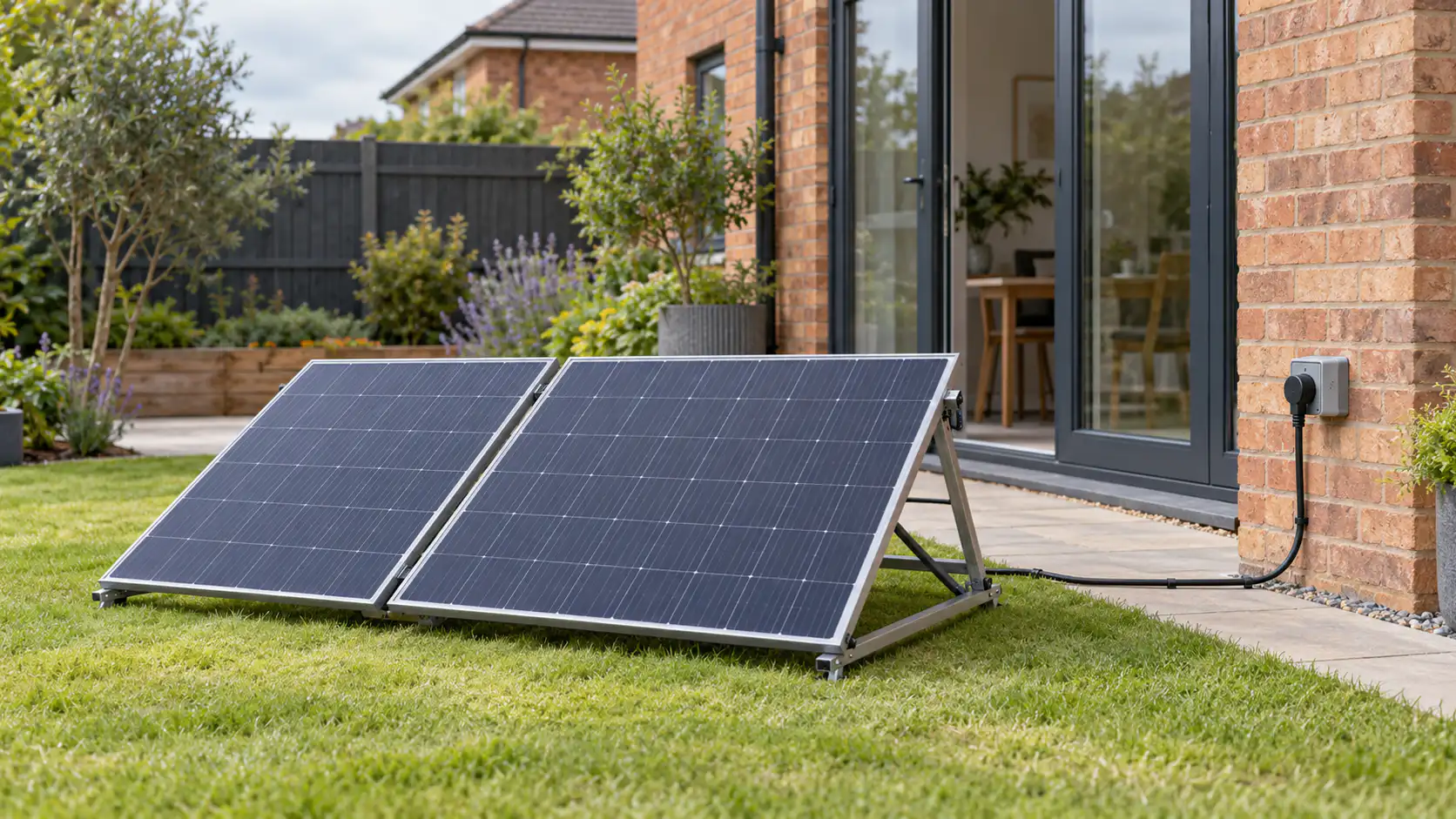
What are plug-in solar panels and how do they work?
A plug-in solar device normally combines one or more photovoltaic panels, a microinverter, mounting equipment and a cable with a plug. The panels turn daylight into direct-current electricity. The microinverter converts it into alternating current that can flow through a suitable socket into the home’s electrical system.
Appliances use that electricity while the panels are generating. If the home needs more power, the grid supplies the difference automatically. If generation is greater than the home is using, the surplus flows to the grid. Unlike a full rooftop array, a plug-in system is smaller, portable and normally self-installed, although electrical or structural work still needs an appropriately qualified person.
Government rules allow compliant devices in England, Scotland and Wales. Energy Saving Trust says they are not currently permitted in Northern Ireland because its separate regulations have not yet been updated. This guide therefore uses “Great Britain” where the new rules apply.
How much do plug-in solar panels cost and save?
Energy Saving Trust says compliant kits cost from about £450 and estimates that an 800W system could generate around 700 kWh a year. Its model uses an unshaded, south-facing system in Manchester, tilted at 30 degrees, a home using 2,500 kWh a year and electricity priced at 24.7p per kWh. Under those assumptions, it estimates an annual bill saving of about £100 for someone at home all day and £70 for someone out during the day.
Those are scenarios, not guarantees. Output changes with location, orientation, angle, shading, weather and the product. Bill savings also depend on the unit rate and how much generation you use immediately. Electricity exported without payment does not reduce the bill, so a household that can shift suitable use into daylight hours may save more than one with little daytime demand.
Use this formula: annual saving = solar electricity used in the home in kWh × electricity unit rate in pounds. For example, if you use 400 kWh of solar generation as it occurs and your import rate is 25p per kWh, the avoided import cost is 400 × £0.25 = £100 a year. A £450 kit would have a simple payback of 4.5 years at that saving, before allowing for installation work, maintenance, changing tariffs, output degradation or lost interest. The standing charge is not avoided.
- Use your own unit rate from a recent bill, not a national average.
- Estimate the share you can use during daylight rather than counting all generation as a saving.
- Include any electrician, mounting, permission, maintenance and insurance costs.
- Treat a retailer’s output and payback claims as assumptions to check, not promised results.
Check the product and your electrics before buying
Choose a device that meets the UK interim product specification and check the exact model on the Energy Networks Association Connect Direct low-carbon technology device register. A compliant device is limited to a maximum average output of 800W. Only one device is allowed at a home: do not connect a second kit or “daisy chain” devices.
The device must plug directly into a suitable mains socket. Do not use an extension lead, cable reel, multiway adaptor, travel adaptor or plug-in RCD adaptor. An outdoor socket must be weatherproof and installed by a qualified electrician. The chosen socket circuit should not also supply lighting or a hardwired appliance such as a boiler or cooker.
Energy Saving Trust advises speaking to a qualified electrician if the consumer unit has old rewireable fuses, the wiring condition is uncertain, a socket must be added or moved, or the panels’ total power is more than 960W. Electrical Safety First recommends an assessment before purchase, particularly in an older property or when the protective devices are unknown, and recommends at least a Type A bidirectional RCD on the intended circuit. Follow the device manufacturer’s instructions and do not improvise connections.
Check location, mounting and permissions
An unshaded south-facing position normally gives the best yield. East- or west-facing panels can still generate but usually produce less; Energy Saving Trust does not recommend a north-facing or shaded position. Use the supplied or approved mounting system and make sure panels cannot fall, lift in high winds, block a walkway or obstruct an escape route.
Tenants, leaseholders and people in managed buildings should get explicit permission from the landlord, freeholder or building manager before buying. Check the lease, building insurance, fire-risk assessment and any restrictions on balconies, external walls, roofs or shared areas. Buildings with combustible cladding, timber balconies or remediation work need particular caution.
Planning rules differ across England, Scotland and Wales, and listed buildings or conservation areas may need additional consent. England has introduced a permitted development right for plug-in solar on houses, but that does not remove lease, landlord, building-safety or local restrictions. Check the relevant planning portal or local authority for the exact property.
Register the device and understand export payments
After installation, register the device with the local Distribution Network Operator. The government-backed consumer guidance says registration is part of the process, and fire-service guidance says to notify the DNO within 28 days. Keep the product details, purchase record, registration confirmation, permission and any electrician’s paperwork.
Do not assume surplus electricity will earn money. Energy Saving Trust says most suppliers normally require an MCS certificate for Smart Export Guarantee payments, which a self-installed plug-in kit is unlikely to have. Some suppliers may accept other evidence or offer a suitable tariff, so ask before relying on export income. The safest financial assumption is that value comes from using solar electricity in the home as it is generated.
A practical pre-purchase checklist
Start with the property rather than the product. Identify a secure, unshaded location and a direct socket route, then confirm permission and electrical suitability. Only after those checks should you compare registered devices, warranties, mounting systems and realistic generation estimates.
Ask the seller to identify the exact model on the approved-device register and explain what is included. Check who is responsible for mounting, a new outdoor socket, DNO registration, faults, returns and end-of-life recycling. Contact the home insurer before installation and keep photographs of the completed setup.
- Confirm that plug-in solar is permitted in your nation and at your property.
- Get landlord, freeholder, building-manager or planning consent where needed.
- Check the consumer unit, RCD type, socket circuit and cable route.
- Verify the exact device model, 800W limit and one-device rule.
- Plan safe mounting, DNO registration and how you will use daytime generation.
Plug-in solar panel FAQs
Are plug-in solar panels legal in the UK?
Compliant plug-in solar devices became legal to buy and use in England, Scotland and Wales on 27 August 2026. Northern Ireland has separate regulations and Energy Saving Trust says they are not currently permitted there.
Can I use an extension lead with plug-in solar panels?
No. Connect the compliant device directly to a suitable mains socket. Do not use extension leads, cable reels, multiway adaptors, travel adaptors or plug-in RCD adaptors.
Can I install more than one plug-in solar kit?
No. Current Great Britain guidance allows one plug-in solar device per home, although that device may include more than one panel. Do not connect or daisy chain multiple devices.
Do plug-in solar panels work during a power cut?
Do not assume they will. Compliant microinverters include protection intended to stop energising the circuit when the grid supply fails. Follow the manufacturer’s instructions and never alter the equipment to create a backup supply.
Will I be paid for electricity exported to the grid?
Not automatically. Most suppliers normally ask for an MCS certificate for Smart Export Guarantee payments, although some may accept other evidence. Check with a supplier before including export income in a payback calculation.
Estimate your electricity bill
Estimate the value of electricity you use as it is generated: multiply self-used solar kWh by your electricity unit rate. Do not subtract the normal daily standing charge, because it still applies while your home remains connected to the grid.
Sources
Legality, product limits, savings assumptions, permissions, electrical checks and the Northern Ireland distinction were checked against these sources on 29 September 2026:
- GOV.UK: Households can save as plug-in solar panels come to market
- GOV.UK: Plug-in solar regulatory amendment and interim product specification
- GOV.UK: Plug-in solar electrical safety study
- Energy Saving Trust: Plug-in solar panels
- Energy Saving Trust: Checks to make before you buy
- Electrical Safety First: Plug-in solar panel safety advice